
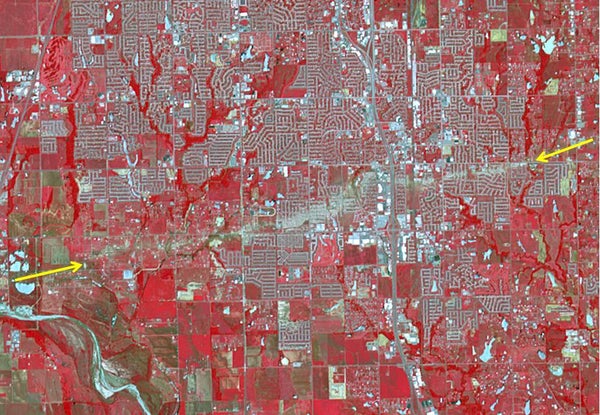
The trail of destruction blazed by last month’s powerful Newcastle–Moore tornado can be seen from space. The entirety of the 27-kilometer path through central Oklahoma slashes across a recent image from NASA's Terra spacecraft.
The photo uses false color to highlight different surface features: red for vegetation, dark blue for water, gray for roads and buildings, and tan for bare fields. The twister’s path shows up as a broad tan swath cutting through a grid of fields and roads. Centered on the city of Moore, the image covers an area of 9.5 by 14.5 kilometers and shows details as small as 15 meters across. The Canadian River meanders across the lower left corner.
The tornado killed 24 people and injured more than 300 others. The Oklahoma Insurance Department has estimated that damages will top $2 billion, making it one of the costliest tornadoes in U.S. history.
On supporting science journalism
If you're enjoying this article, consider supporting our award-winning journalism by subscribing. By purchasing a subscription you are helping to ensure the future of impactful stories about the discoveries and ideas shaping our world today.
The production of this and other pictures of the Earth’s surface is part of a broader NASA program to study the planet. Terra, the flagship of the Earth Observing System, uses an array of instruments to study climate change, weather, airborne pollutants, the water cycle and many other phenomena. Launched in 1999, it is a joint mission between the U.S., Japan and Canada.
The Oklahoma image was captured by the satellite’s ASTER (Advanced Spaceborne Thermal Emission and Reflection Radiometer) instrument. ASTER is Terra’s “zoom lens,” providing detailed close-ups across a wide range of the electromagnetic spectrum. Fourteen filters allow mission scientists to isolate wavelengths from infrared to visible light.
—Christopher Crockett