
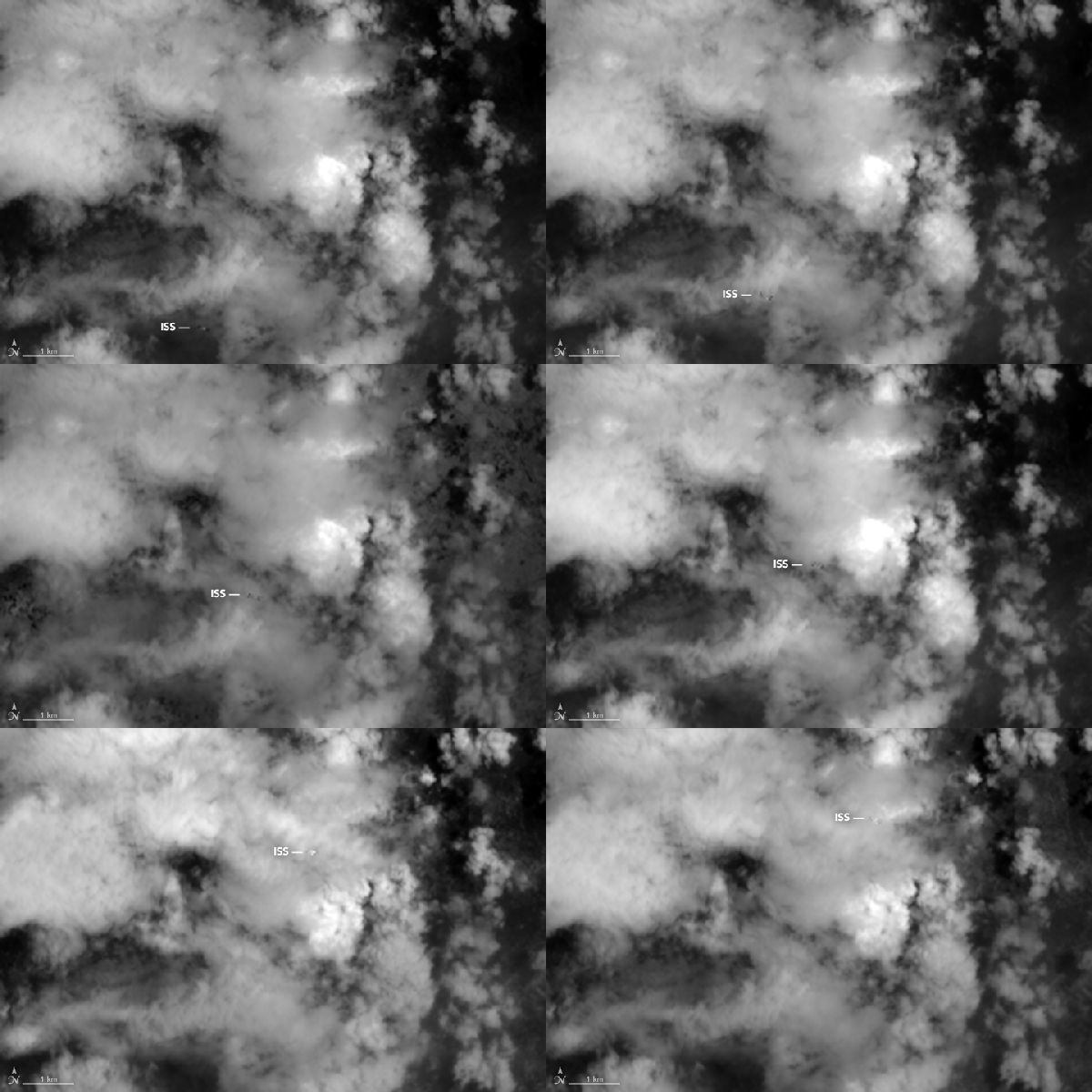
A satellite captured a birdꞌs-eye view of the International Space Station (ISS) orbiting Earth, revealing spectacular images just released by NASA.
The Landsat 8 is an Earth-observing satellite, and hovers an average of 438 miles (705 kilometers) above the surface of the planet. With the Space Station orbiting at only 250 miles (400 km) above the surface, the Landsat 8's Operational Land Imager (OLI) gets a unique view of the ISS when the two orbits align.
On June 19, 2016, the Landsat 8's OLI captured images of the ISS over the state of Odisha in eastern India. Amid a background of clouds, the ISS can be seen passing through the frame in an animation composed of eight separate images collected just fractions of a second apart. [Earth from Above: 101 Stunning Images from Orbit]
On supporting science journalism
If you're enjoying this article, consider supporting our award-winning journalism by subscribing. By purchasing a subscription you are helping to ensure the future of impactful stories about the discoveries and ideas shaping our world today.

Known as an "underflight," it is relatively rare for the ISS and Landsat 8's paths to cross, according to Michael Gartley, a scientist at the Rochester Institute of Technology.
"On average, ISS underflights seem to happen a few times a year," Gartley told NASA's Earth Observatory.
There were two other underpasses this year, occurring on April 17 and Feb. 23, and one in 2015, on May 1.
A number of other satellite sensors can capture such images, if the orbits line up in just the right way. For instance, both Landsat 7 and 5 have glimpsed the ISS in the past.
In a 2013 study, Gartley developed an algorithm to search the image archive of the Advanced Land Imager (ALI) on a satellite called EO-1. Gartley found that the ALI sensor serendipitously captured images of "space objects" on 12 different occasions over the course of a decade.
With about 5,000 known objects orbiting the planet at an altitude below many NASA Earth-observing satellites, Gartley is developing a similar algorithm for Landsat 8 to search for images of these underflights.
"[Earth-observing satellites] present an unlikely tool for aiding the space situational awareness community in their task of monitoring the growing population of low-Earth orbit space objects," Gartley told the Earth Observatory. "Although the frequency of underflights of space objects is low, the resulting signatures can provide well-calibrated location information."
Copyright 2016 LiveScience.com, a Purch company. All rights reserved. This material may not be published, broadcast, rewritten or redistributed.