
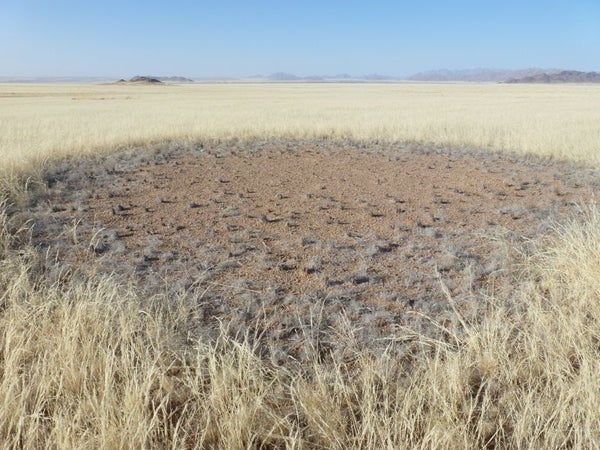
The eastern boundary of the Namib Desert is home to tens of thousands of "fairy circles," barren patches within the grassland. They are typically concave, although some are flat, and they are often surrounded by a ring of unusually tall grass.* Scientists are still unsure what causes fairy circles, but a paper published today in Public Library of Science ONE describes the life cycle of the formations, using both field data and satellite images.
Walter Tschinkel, a biologist at The Florida State University, compared satellite images of the circle-strewn area in 2004 with images from 2008, noting whether the formations were present in both years and what changes had occurred in size, shape or vegetation. He also studied ground photographs of circles and images from Google Earth for a more detailed look at the sizes and locations of circles as well as how they changed over time.
Previous research had indicated that the fairy circles were not static, but Tschinkel’s work was the first to document the details of the life cycle:birth, maturation, enlargement and death—or revegetation. His paper describes the different phases and estimates the life span of a fairy circle to be 23 to 75 years, depending on size. The picture here shows a fairy circle in its birth stage: the grass in the ring is dead but has not completely disappeared, and the circle is still flat rather than concave.*
On supporting science journalism
If you're enjoying this article, consider supporting our award-winning journalism by subscribing. By purchasing a subscription you are helping to ensure the future of impactful stories about the discoveries and ideas shaping our world today.
Tschinkel's work does not answer the question of why fairy circles appear, but it helps to pin down the processes researchers will need to study to solve that mystery. “Every good piece of science starts with a good description of the phenomenon, and that’s what I’ve provided here,” he says.
Hypotheses for what causes these formations have focused on termite activity; presence of a toxin or absence of a nutrient in the soil; competition for water between plants; gas deposits; and even radioactivity, among others. So far, there is little evidence to support any of these theories, and data to discount some, but nothing is known conclusively.
Tschinkel says, “The man who founded the Namib Rand nature reserve [where the research took place] hopes that nobody ever solves the mystery of the fairy circles, and I can understand that.” Tschinkel assured him not to worry; science is still a long way from the answer.
—Evelyn Lamb
*Correction (7/2/12): These sentences were edited after posting. They originally stated the circles were typically mounds, rather than concave.