
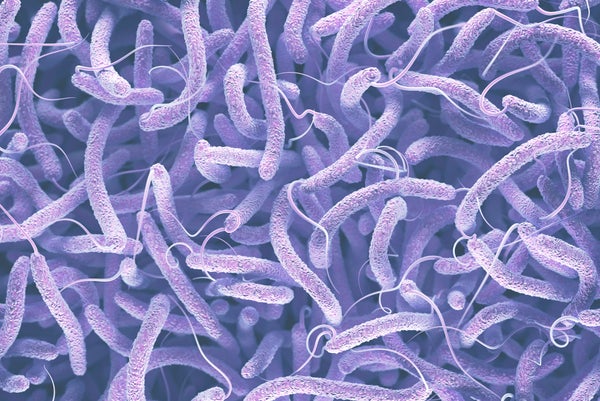
Orbiting satellites can warn us of bad weather and help us navigate to that new taco joint. Scientists are also using data satellites to solve a worldwide problem: predicting cholera outbreaks.
Cholera infects millions of people each year, leading to thousands of deaths. Often communities do not realize an epidemic is underway until infected individuals swarm hospitals. Advanced warning for impending epidemics could help health workers prepare for the onslaught—stockpiling rehydration supplies, medicines and vaccines—which can save lives and quell the disease’s spread. Back in May 2017 a team of scientists used satellite information to assess whether an outbreak would occur in Yemen, and they ended up predicting an outburst that spread across the country in June.
Testing the Waters
On supporting science journalism
If you're enjoying this article, consider supporting our award-winning journalism by subscribing. By purchasing a subscription you are helping to ensure the future of impactful stories about the discoveries and ideas shaping our world today.
Cholera is a waterborne bacterial disease that causes intestinal distress and dehydration. The illness can progress rapidly, peaking within hours or days. An overwhelming majority of cases occur in developing countries, exasperated by poor sanitation, urban slums and refugee camps.
Cholera can spread two ways: endemically or epidemically. Coastal communities are hot spots for endemic episodes. Ocean-dwelling cholera flourish in dry and hot seasons, and can be carried ashore by high tides. Coastal towns and villages become infected, but in many locales the process happens regularly and residents are reasonably prepared for these waves of infection.
Epidemic contamination is much less predictable, and can take inland communities by surprise. “They are not prepared—they don’t have vaccines, they don’t have dehydration solutions,” says Antarpreet Jutla, a hydrologist and civil engineer at West Virginia University who led the Yemen study. Cholera can spread easily via water, and with a burst of warm temperatures, high precipitation and poor water infrastructure, an epidemic can blossom quickly.
Disease in Real Time
Quickly collecting ground data about these kinds of events can be challenging, especially in chaotic locations. Yemen is a textbook case. “Yemen has massive civil unrest, people are moving around, [there is] political instability—there’s no way for us to get a single data point,” Jutla says. But satellites gave his team a way to assess the disease risk from the sky, and without being in the country.
At the American Geophysical Union annual meeting in December, Jutla presented the group’s prediction model of cholera for Yemen. The team used a handful of satellites to monitor temperatures, water storage, precipitation and land around the country. By processing that information in algorithms they developed, the team predicted areas most at risk for an outbreak over the upcoming month.
Weeks later an epidemic occurred that closely resembled what the model had predicted. “It was something we did not expect,” Jutla says, because they had built the algorithms—and calibrated and validated them—on data from the Bengal Delta in southern Asia as well as parts of Africa. They were unable to go into war-torn Yemen directly, however. For those reasons, the team had not informed Yemen officials of the predicted June outbreak.
The successful prediction did give the team confidence that their model, built on a variety of data types, is on the right track. “One of the things I like,” says Michael Wimberly, an ecologist at South Dakota State University, is that they are not looking “only at correlation to rainfall.” Wimberly uses remote-sensing technologies to monitor diseases like West Nile virus, and was not involved in the study. He says the cholera model is well grounded in hydrology and epidemiology. “They have an understanding of different types of epidemics that occur in different seasons; it’s very sophisticated.”
Helping the Sick
With a fast-moving disease like cholera, advanced warnings matter, especially in remote places. They offer a major advantage, says study co-author Rita Colwell, a microbiologist at the University of Maryland, College Park, and a former director of the National Science Foundation. Colwell has been studying global infectious diseases for decades, and says their model for cholera is highly predictive. “This is a mechanism that will help preparation with medical supplies and vaccinations.”
Wimberly agrees. “That’s the value of disease forecasting: to be able to anticipate the right place, a little bit ahead of time, so we can get those tools out there.”
The team is cautious about broadcasting disease forecasts, not wanting to create public panic. They are working with several international agencies on the best way to communicate future predictions. They are also developing a platform that uses hydrologic and societal conditions to determine the probability of cholera outbreaks globally—with a goal of providing warnings that offer four weeks of lead time.

