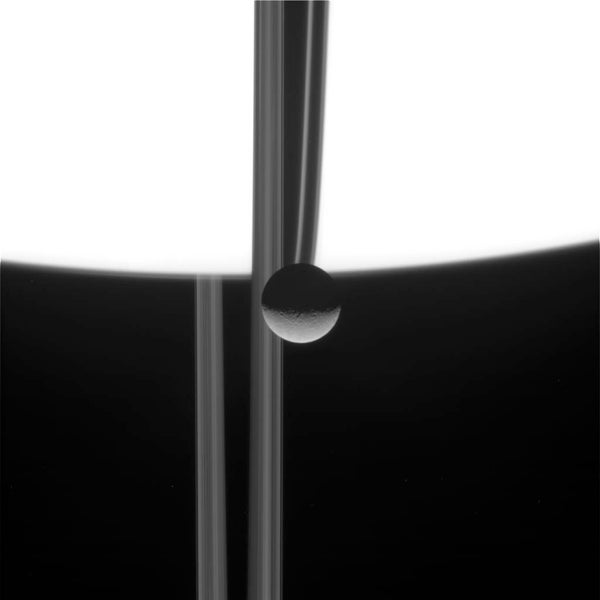
Saturnian trifecta: The planet, its rings and a moon
On November 8, the Cassini spacecraft snapped this photo of Rhea , Saturn's second largest moon, against a backdrop of the gas giant planet and its famed rings.
NASA/JPL/Space Science Institute
Join Our Community of Science Lovers!
On supporting science journalism
If you're enjoying this article, consider supporting our award-winning journalism by subscribing. By purchasing a subscription you are helping to ensure the future of impactful stories about the discoveries and ideas shaping our world today.
On November 8, the Cassini spacecraft snapped this photo of Rhea, Saturn's second largest moon, against a backdrop of the gas giant planet and its famed rings. The spacecraft has returned countless striking images since it arrived at Saturn in 2004, but it continues to carry out exploratory science, as well.
Less than a week before this snapshot was taken, Cassini plunged through a misty plume spewing from the south pole of Enceladus, another Saturnian moon. During that November 2 flyby, designed to gather data about the mysterious plume's composition, the spacecraft buzzed Enceladus at a distance of roughly 100 kilometers. For comparison, Cassini was nearly two million kilometers from Rhea when the image above was captured.
It’s Time to Stand Up for Science
If you enjoyed this article, I’d like to ask for your support. Scientific American has served as an advocate for science and industry for 180 years, and right now may be the most critical moment in that two-century history.
SciAm always educates and delights me, and inspires a sense of awe for our vast, beautiful universe. I hope it does that for you, too.
If you subscribe to Scientific American, you help ensure that our coverage is centered on meaningful research and discovery; that we have the resources to report on the decisions that threaten labs across the U.S.; and that we support both budding and working scientists at a time when the value of science itself too often goes unrecognized.