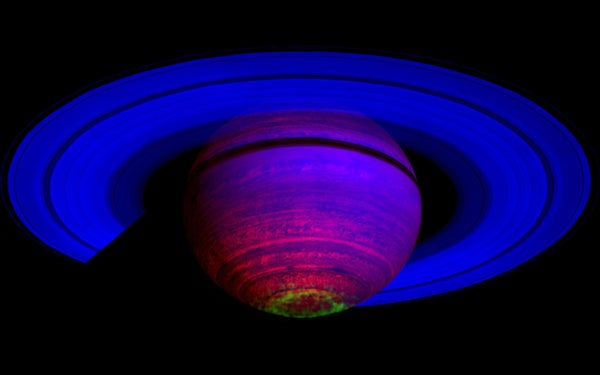
Saturn's infrared auroral glow, made colorful

Majestic, ringed Saturn little resembles the relatively tiny blue marble that is Earth, but the massive gas giant planet is home to at least one phenomenon that would be familiar to high-latitude dwellers here on Earth.

NASA/JPL/University of Arizona/University of Leicester

Join Our Community of Science Lovers!


On supporting science journalism

If you're enjoying this article, consider supporting our award-winning journalism by subscribing. By purchasing a subscription you are helping to ensure the future of impactful stories about the discoveries and ideas shaping our world today.


Majestic, ringed Saturn little resembles the relatively tiny blue marble that is Earth, but the massive gas giant planet is home to at least one phenomenon that would be familiar to high-latitude dwellers here on Earth. Although the underlying mechanisms may differ somewhat, Saturn has northern and southern lights at its poles, just as Earth does.

Auroras arise when charged particles are funneled along converging magnetic field lines and into the upper atmosphere at the poles. At Earth, the effect is dominated by the solar wind; at Saturn a complex mixture of other geomagnetic phenomena appear to contribute as well. Charged particles striking Saturn's upper atmosphere ionize hydrogen atoms and produce infrared radiation, whereas related processes also give off Saturnian auroras at ultraviolet and radio wavelengths.

The infrared auroras show up in green in this false-color composite from NASA's Cassini spacecraft, stitched together from 65 individual observations taken by the probe's Visual and Infrared Mapping Spectrometer in 2008. According to a NASA news release, the auroral light appears in the near infrared at wavelengths of three to four microns. Blue designates reflected sunlight at two microns, and red represents thermal emissions at five microns.

It’s Time to Stand Up for Science

If you enjoyed this article, I’d like to ask for your support. Scientific American has served as an advocate for science and industry for 180 years, and right now may be the most critical moment in that two-century history.

I’ve been a Scientific American subscriber since I was 12 years old, and it helped shape the way I look at the world. SciAm always educates and delights me, and inspires a sense of awe for our vast, beautiful universe. I hope it does that for you, too.

If you subscribe to Scientific American, you help ensure that our coverage is centered on meaningful research and discovery; that we have the resources to report on the decisions that threaten labs across the U.S.; and that we support both budding and working scientists at a time when the value of science itself too often goes unrecognized.

In return, you get essential news, captivating podcasts, brilliant infographics, can't-miss newsletters, must-watch videos, challenging games, and the science world's best writing and reporting. You can even gift someone a subscription.

There has never been a more important time for us to stand up and show why science matters. I hope you’ll support us in that mission.

Thank you,

David M. Ewalt, Editor in Chief, Scientific American

Subscribe