
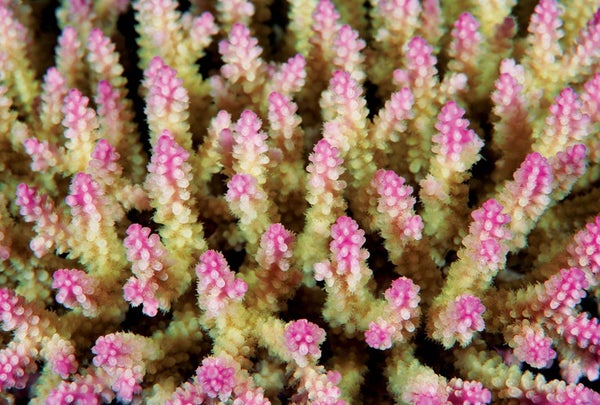
A routine dentist’s tool may soon help with more than just oral health. A new study has found that dental imaging scanners can double as portable devices to track the growth of baby corals—a crucial predictor of how reefs will fare amid climate change.
Heat stress can kill mature coral reefs and curtail their regrowth. “Growth, reproduction and survival are the main things that we’re always looking at in terms of how healthy reefs are,” says marine biologist Kate Quigley of the Australian Institute of Marine Science. By modeling baby corals in 3-D, researchers can track how well they branch, develop complex shapes and reach reproducing size. If harsh water conditions make corals grow too slowly, a reef won’t recover.
Corals this small are difficult to model in 3-D; researchers can CT scan them, dip them in wax or laboriously stitch the measurements together from a commercial 3-D scanner—but these methods can be slow and provide lower-resolution views. So one day, as Quigley’s dentist used a wandlike device that focused light to create a detailed 3-D tooth model, Quigley got an idea. If this device could measure her chompers’ crevices in detail, she thought, it should be able to scan tiny living corals, too—both teeth and coral are calcium-based and wet.
On supporting science journalism
If you're enjoying this article, consider supporting our award-winning journalism by subscribing. By purchasing a subscription you are helping to ensure the future of impactful stories about the discoveries and ideas shaping our world today.
For a study published in Methods in Ecology and Evolution, Quigley tested the scanning wand and found that it offered a cheap, easy and portable way to model baby corals significantly faster and at higher resolution than currently available techniques. This tool could let scientists more easily examine how coral species endure stress.
“Baby corals are critical for reef restoration and recovery from disturbances like hurricanes and thermal heat waves. Unfortunately, they are the stages we know least about because they are so difficult to measure accurately without great expense,” says Hawai’i Institute of Marine Biology researcher Joshua Madin, who was not involved in the study. “This paper is a great example of taking a mature technology developed in another field and applying it to coral reef science.”