
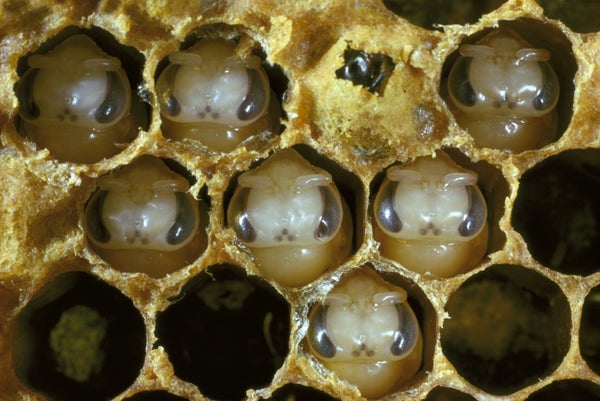
A dozen years ago beekeepers started reporting that frightening numbers of their honeybees (Apis mellifera) were mysteriously dying. Scientists have since discovered multiple reasons, but “diseases are by far the main cause of problems with honeybee health right now,” says Leonard Foster, professor of biochemistry and molecular biology at the University of British Columbia. The insects are afflicted by scourges ranging from varroosis (caused by mites) to the bacterial disease American foulbrood. Now a new study reveals how the smell of dead honeybees could be used to help identify and breed healthier colonies.
Scientists have long known honeybees remove dead or diseased individuals from among their young, or “brood,” to restrict the spread of pathogens through a colony. British Columbia researcher and study lead author Alison McAfee, along with Foster and other colleagues, wanted to better understand why some colonies are more fastidious about this cleanup than others are. They selected two chemicals naturally produced by honeybees, oleic acid and beta-ocimene, whose odors they thought might act as cleanup signals. Many insects release oleic acid at death, and honeybee larvae release beta-ocimene to signal their need for food. Young honeybees emit both compounds when they die.
The researchers performed a series of tests to determine if these odors were connected to hygienic behavior. In one experiment, they added oleic acid and beta-ocimene to a live brood developing in comb cells, in an attempt to trick worker bees into thinking the brood was dead. The workers removed more brood members from cells doused with a blend of both chemicals, compared with insects exposed to only one of the odors or to a control chemical, the team reported in April in Scientific Reports. The researchers think that beta-ocimene alerted workers to attend to the brood and that oleic acid triggered them to remove the “dead.”
On supporting science journalism
If you're enjoying this article, consider supporting our award-winning journalism by subscribing. By purchasing a subscription you are helping to ensure the future of impactful stories about the discoveries and ideas shaping our world today.
The team also found a link between the odors and the genetics that drive honeybees' hygienic behavior. Because some bees appear to respond more strongly to “death” smells by cleaning, these findings may help scientists develop a better way to breed more hygienic bees. “The fact that they have a mechanism by which the bees can identify these smells—and they actually get a plausible mechanism with their genetics—is really exciting,” says Jay Evans, a research scientist at the U.S. Department of Agriculture, who was not involved in the study. “If validated, there could be a way to measure that trait, so that beekeepers could select a bee breed that's hygienic based on genetics.”