
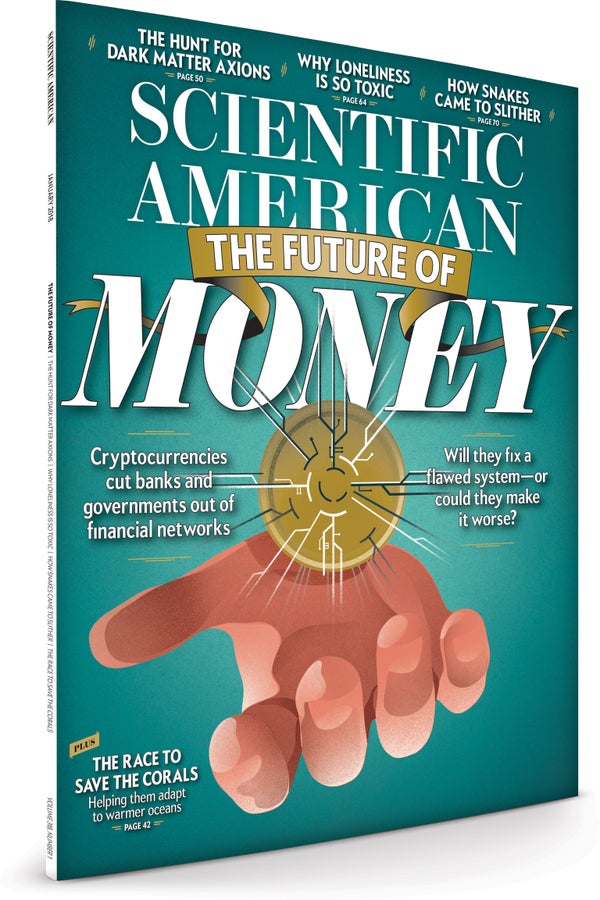
As a member of an editorial team covering the international endeavor known as science, I often find myself on airplanes. Recently my seatmate was a bright young woman. She spoke passionately about her specialty areas of design and marketing and was also eager to hear about my career.
“Science?” she asked. “Why would you write about that instead of, say, culture or design?” I was surprised by the question but quickly realized she was genuinely curious. I told her I couldn't think of anything more exciting than covering science. I tried to explain: science isn't something apart, a bunch of people in lab coats in the ivory towers of academia—it's part of everything, the way we advance discoveries about the workings of our world and create innovations to solve problems and address human needs.
Take money. Today's monetary system has become too complex to regulate and manage. Now big data and the emergence of digital currencies and digital contracts are making it possible to simulate every trade and transaction, the better to understand all potential outcomes. In our special report “The Future of Money,” Alexander Lipton and Alex “Sandy” Pentland, both at the Massachusetts Institute of Technology, discuss these phenomena and the rise of digital currencies. Distributed monetary systems, with large alliances of diverse players, could eventually bring transparency, accountability and equity to global finance. If you finally want to grasp what people are talking about with Bitcoin and blockchain, “The World Bitcoin Created” is a wonderfully designed explainer by journalist John Pavlus. In “The Evolution of Trust,” cultural anthropologist Natalie Smolenski argues that digital currencies are about more than money—they represent the evolution of trust itself.
On supporting science journalism
If you're enjoying this article, consider supporting our award-winning journalism by subscribing. By purchasing a subscription you are helping to ensure the future of impactful stories about the discoveries and ideas shaping our world today.
Elsewhere in the issue, you can see how science is working on new breeding and distribution techniques to save the coral reefs; a way to gain a better understanding of dark matter through the search for whether axion particles exist; a probe into the cause and solutions for the toxic condition of social disconnection, also known as loneliness; and even how to elucidate the long-sought origins of how snakes got their slither. We invite you to dive in. Science awaits.