
In 1952, educators and broadcasters met in State College, Pa., to discuss the potential of a new technology—television—for education. The mood was hopeful yet tempered with skepticism. One attendee pessimistically compared the medium with the potential of “atomic energy”; perhaps neutral, but possibly dangerous.
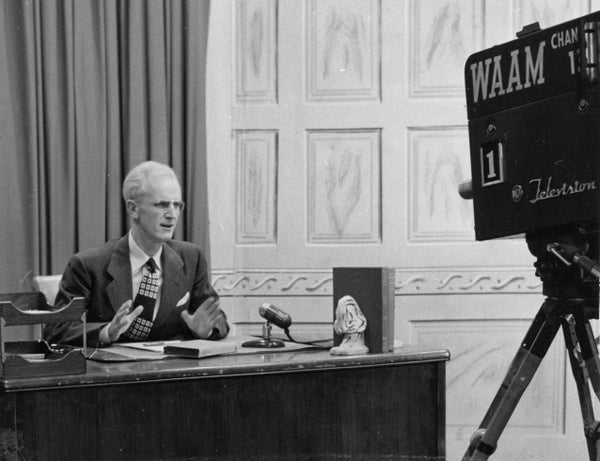
One of the special guests of this conference was a slight man, with horn-rimmed glasses and wisps of white hair. He suggested, optimistically, that television was actually the perfect tool for education. “The potential is there, the professional enthusiasm exists, and the medium can be the instrument of swift advance toward lasting values,” he argued.
And, he knew what he was talking about. Under the auspices of Johns Hopkins University, Lynn Poole had launched the first nationwide television program about science. The Johns Hopkins Science Review ran from 1948 until 1956, just before the launch of Sputnik. Poole and his wife, Gray Johnson, pioneered the science television genre in the United States.
On supporting science journalism
If you're enjoying this article, consider supporting our award-winning journalism by subscribing. By purchasing a subscription you are helping to ensure the future of impactful stories about the discoveries and ideas shaping our world today.
This summer, as I’ve heard my colleagues talk about how they’re preparing to lecture on Zoom and other video platforms, I think back to what it must have been like for Poole to work with a new educational medium and create a whole new genre of television: the science series. Television was one of the first forms of remote teaching; it allowed students to be connected to a professor, miles away—even across the country!
The Johns Hopkins Science Review was the first science series to be broadcast from San Francisco to New York City. Decades later, what might Poole, a pioneer of the television lecture, teach us about educating students remotely? Rummaging through my archive, I actually found an article printed in the 1950s, listing Poole’s suggestions for educators of the small screen. Here are Poole’s top three television teaching tips:
Television is obviously show business. At his center, Lynn Poole was a showman. He wasn’t a scientist himself—he was a jack-of-all trades: a former modern dancer, an art collector and an amateur classics scholar. When Johns Hopkins University hired Poole as their director of public relations, they probably expected that he would film their professors standing in front of blackboards. That’s what passed for educational television in the late 1940s.
But Poole wanted to put his professors on stage and expected them to perform. He was the first educator to recognize the value of televised spectacle. “One thing that educators must not forget is that television is an entertainment medium,” Poole said in an interview, “They have to dramatize.” The Johns Hopkins Science Review intentionally blended entertainment and education together. Like just like other prime-time television shows, Poole entertained his audience by featuring scientific experiments, humorous skits and dramatic reenactments. In one episode featuring Wernher von Braun, an astronaut wearing a papier-mâché helmet appeared to walk on the surface of the moon, while a 12-foot plywood rocket loomed above him.
If you can’t show it, don’t talk about it for more than one minute. Poole urge his colleagues to think through the presentation of materials and anticipate how their audience would understand what was on-screen. He believed that the key to a successful television program was careful attention to detail. Poole told colleagues that television educators needed to be “willing to expend the same thought and energy used in preparation for classroom teaching.” A single episode of the Johns Hopkins Science Review, he noted, required around 200 hours of preparation. Poole worked with Johnson to brainstorm material for the program. He planned almost every second of the program. This was a problem for his scientific guests, who were not used to the demands of a live program. If they ran out of time in the middle of writing out a mathematical formula, Poole would actually roll their blackboards off-stage. He also gave them feedback on how to perform on camera. In an interview, Poole noted, “[Scientists] must learn to stay within camera range, not weave in the cobralike fashion used in the classroom…. They must learn to pick up objects slowly and hold [them] immobile so the viewer can get a good look.”
Give the viewer credit for intelligence. Poole respected his scientific guests, and he respected his audience. He believed the best thing that broadcasters could do was to be as honest and transparent as possible. While the university suggested using actors, Poole insisted on using real scientists on screen. “Mrs. Jones watching Dr. Ralph Witt, head of the Johns Hopkins plastics research laboratory, can see how he tests and does his research,” Poole remarked. “He’s not a polished actor; he’s a pipe-smoking research man who knows what he’s doing, and Mrs. Jones knows it.”
On screen, Poole often talked directly to his viewers. He asked them to send him their questions about science, and he would try to answer them on air. As a nonscientist himself, he reassured his viewers that the show was for everyone, not just scientists. During the show’s seven-year run, a national fan base coalesced around the series. Poole received hundreds of letters from high school teachers, bus drivers, engineers and parents around the United States. One viewer in New Jersey wrote, “You don’t think we’re morons. Keep it up!”
Using these principles of broadcasting, Poole created a successful science television that won multiple Peabody Awards. Television producers came from Mexico, France and Lebanon to learn Poole’sstyle of educational broadcasting. In a period where people were very much skeptical about virtual education, Poole’s program proved that viewers could enjoy learning about science via remote learning. There were many talented science educators that arose on television in the 1950s, such as Don Herbert, Julius Sumner Miller, Daniel Posin, and Hubert Alyea. Decades later, Carl Sagan and Ann Druyan perfected the form in their television opus Cosmos. For my generation, we were lucky to have Bill Nye and Neil deGrasse Tyson thrill us with the wonders of science.
Today, there are new video series released every month, such as Netflix’s Connected, that tell stories about science in exciting ways. It’s worth realizing that many of the fundamentals of good science broadcasting still hold true. You should always respect your audience. You should always prepare your lectures. And, most importantly, you should try to have fun with your lectures. For those of us who stuck teaching with Zoom this fall, we have an opportunity to take these lessons to heart. Much like Poole, we can learn the nuances of remote learning and take advantage of a new, dynamic form of educational technology.