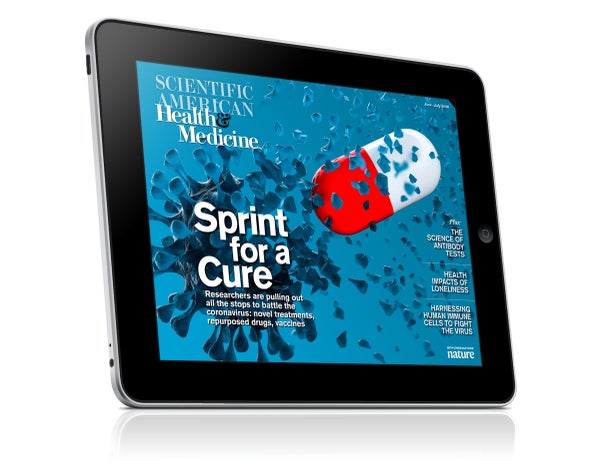
Science without the Luxury of Time

Researchers are pulling out all the stops to battle the coronavirus; novel treatments, repurposed drugs, vaccines

Scientific American

Join Our Community of Science Lovers!


On supporting science journalism

If you're enjoying this article, consider supporting our award-winning journalism by subscribing. By purchasing a subscription you are helping to ensure the future of impactful stories about the discoveries and ideas shaping our world today.


It’s long been a sticking point between the public and science: a disaster befalls us unexpectedly, and we, of course, want answers immediately. But in the cruelest kind of irony, most science cannot be done in a rush. The beauty of the scientific method is its careful use of observation over time—tracking the migration patterns of birds for decades, for example. Or, when it comes to drug development, the gold-standard randomized controlled clinical trial, where an equal proportion of patients are given no treatment at all to serve as a baseline against which researchers can compare any effects of the drug being given to the other participants. These careful procedures give us the best science. They take time and a kind of cool detachment, allowing data to roll in before conclusions are drawn.

But tell that to the family of a woman in severe respiratory distress from COVID-19. Waiting to know which of the handful of potential treatments for the novel coronavirus might be effective is a privilege of time that many patients don’t have. In this issue, health and medicine editor Tanya Lewis gives a detailed survey of the batch of drugs researchers are rushing to test scientifically, even as they are being put to the test on a case-by-case basis (see “Here’s What We Know about the Most Touted Drugs Tested for COVID-19”). Elsewhere, journalist Stacey McKenna takes a sobering look at what researchers actually know about immunity to the virus (see “What Immunity to COVID-19 Really Means”), and biologist William A. Haseltine evaluates the limitations of a vaccine solution (see “Can We Really Develop a Safe, Effective Coronavirus Vaccine?”).

The common theme to all these riveting stories? Making safe and effective medicine needs time—the one luxury we now cannot afford.

Andrea Gawrylewski is chief newsletter editor at Scientific American. She writes the daily Today in Science newsletter and oversees all other newsletters at the magazine. In addition, she manages all special editions and in the past was the editor for Scientific American Mind, Scientific American Space & Physics and Scientific American Health & Medicine. Gawrylewski got her start in journalism at the Scientist magazine, where she was a features writer and editor for "hot" research papers in the life sciences. She spent more than six years in educational publishing, editing books for higher education in biology, environmental science and nutrition. She holds a master's degree in earth science and a master's degree in journalism, both from Columbia University, home of the Pulitzer Prize.

More by Andrea Gawrylewski
SA Health & Medicine Vol 2 Issue 3This article was published with the title “Science without the Luxury of Time” in SA Health & Medicine Vol. 2 No. 3 ()
doi:10.1038/scientificamerican062020-McA8PGqtPLEHFsXJAOSTQ

It’s Time to Stand Up for Science

If you enjoyed this article, I’d like to ask for your support. Scientific American has served as an advocate for science and industry for 180 years, and right now may be the most critical moment in that two-century history.

I’ve been a Scientific American subscriber since I was 12 years old, and it helped shape the way I look at the world. SciAm always educates and delights me, and inspires a sense of awe for our vast, beautiful universe. I hope it does that for you, too.

If you subscribe to Scientific American, you help ensure that our coverage is centered on meaningful research and discovery; that we have the resources to report on the decisions that threaten labs across the U.S.; and that we support both budding and working scientists at a time when the value of science itself too often goes unrecognized.

In return, you get essential news, captivating podcasts, brilliant infographics, can't-miss newsletters, must-watch videos, challenging games, and the science world's best writing and reporting. You can even gift someone a subscription.

There has never been a more important time for us to stand up and show why science matters. I hope you’ll support us in that mission.

Thank you,

David M. Ewalt, Editor in Chief, Scientific American

Subscribe