
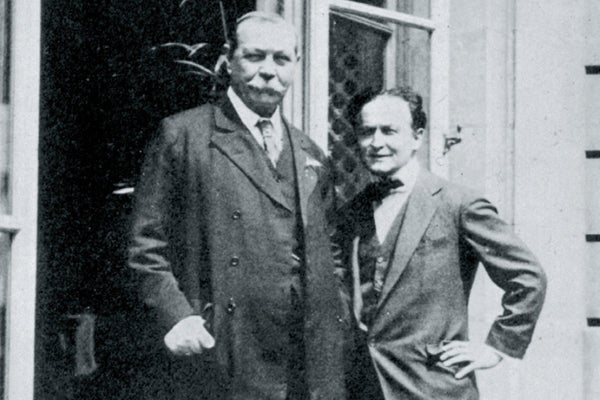
In 1922 Scientific American announced a high-stakes international contest to find scientific proof of ghosts. The competition offered $5,000,and it pitted top scientists of the day against wildly popular psychic mediums. The contest also escalated a growing feud between two famous friends: renowned magician and escape artist Harry Houdini and Sherlock Holmes creator Arthur Conan Doyle.
The magazine's interest in the afterlife was not so much an anomaly but a product of the time. The U.S. and Europe were reeling from enormous numbers of deaths in the Great War and the 1918 influenza pandemic. To their families and friends, the spirits of the newly departed seemed to be appearing everywhere-in parlor séances with mediums and at kitchen tables through store-bought Ouija boards. “There was this desperation, this collective yearning to know if there was existence after death,” says David Jaher, whose book The Witch of Lime Street chronicles the period.
In parallel to this supernatural fascination, these years were filled with breakneck technological innovation. Electricity and radio were making what was previously unimaginable possible: instant illumination and voices from afar appearing out of thin air. “The science and technology of the time all seemed very magical to people,” Jaher says. “There was such a thin line between what is a scientific miracle and what is a supernatural miracle.” So cross-Styx communication, or spiritualism, did not seem entirely unreasonable.
In an unlikely turn, Conan Doyle, a trained medical doctor as well as the author behind a famously rational detective, had become one of the highest profile proponents of spiritualism on either side of the Atlantic. He was convinced that, among other things, he had been able to communicate with his dead son. He even toured the U.S. in the early 1920s to lecture on the topic.
On the debunking side was Houdini. The magician and Conan Doyle had briefly been friends, but then the writer tried to arrange for Houdini to receive a message from his dead mother via a medium. The illusionist saw that the act was a ruse, however, and he easily spotted trickery by other mediums as well, such as the use of a wire to move a distant object. He was unhappy with Conan Doyle and condemned the work of mediums as a “racket,” Jaher says, “defrauding the bereaved.”
Scientific American regularly covered spiritualism as an interest of science. Many well-respected scientists, including renowned physicist Oliver Lodge—a magazine contributor—were vocal defenders of the practice's legitimacy. While in the U.S., Conan Doyle contacted Scientific American's publisher, Orson Munn, and suggested that instead of covering psychic work as an ongoing debate, the magazine ought to take an official stance on it. Munn agreed.
Munn and the magazine's editors decided that the best way to determine their stance would be to hold the aforementioned contest, which was refereed by a committee consisting of two scientists, two psychic experts and the skeptical Houdini. The contest promised to use the latest scientific tools to ascertain once and for all whether there were true conduits to the spirit world. This equipment included “induction coils, galvanometers, electroscopes, etc., some with the purpose of testing the electrical condition of the medium at the moment when phenomena are produced, others to prove the presence or absence of material objects,” the magazine explained in the March 1923 issue.
The psychic tests, initially performed in the magazine's library, got off to a slow and rocky start. Many of Conan Doyle's most revered mediums refused to appear in a public competition. Contestants who did show were quickly dismissed by the judges as tricksters. “I never saw such awkward work in my life,” Houdini noted after one of the early sessions.
And so it went, in fits and false apparition starts, for more than a year. Then news began to emerge about a medium in Boston who did not take money for her séances and who seemed to have no particular motive for being a conduit. The woman, Mina Crandon, was married to a respected surgeon and so loathed publicity– unlike other mediums the magazine had encountered–that she received a pseudonym: Margery. So an editor and some of the contest judges set off to the Crandons' residence on Lime Street in Boston for preliminary visits. Bells rang in the dark, a Victrola played without explanation and the voice of the medium's dead brother conversed with observers.
But Margery could not convince Houdini, who called her “all fraud.” The Scientific American committee eventually reached the same conclusion after observing nearly 100 séances. In 1925 the magazine announced, “The famous Margery case is over so far as the Scientific American Psychic Investigation is concerned.”
Notably, however, the publication did not call humbug on the entire field and kept its committee going. As late as 1941, it upped the prize to $15,000. But it seemed unconvinced that conclusive evidence would surface on either side. In a 1942 article, a writer for the magazine mused that “it is, perhaps, too much to hope that it may ever be permanently settled.”