
Collaboration has almost become a dirty word in America, tending more toward a definition of “traitorous cooperation with an enemy” and away from “working with others to create something.” This saddens me, as it should you. We need to find common ground to work together and to share—at all levels.
Although election angst is on many of our minds, I am not pointing simply at our politicians here, but to people in all walks of life, and to my fellow scientists in particular. The response of the global scientific community to COVID-19 demonstrates what a multi-researcher effort can accomplish if we do it together.
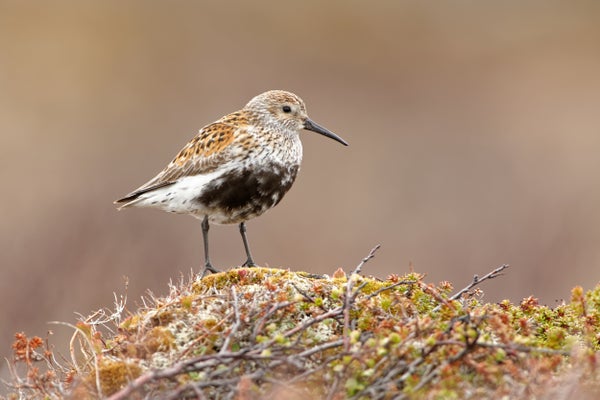
The Arctic is entering a new ecological state, with alarming implications for humanity and wildlife. How will birds cope with the changing weather conditions and anthropogenic, or human, factors? Many shorebirds, for example, migrate from wintering areas in the tropics to breeding areas in the Arctic, and they must cope with the naturally extreme differences between these areas while attempting to time their arrival to the Arctic correctly.
On supporting science journalism
If you're enjoying this article, consider supporting our award-winning journalism by subscribing. By purchasing a subscription you are helping to ensure the future of impactful stories about the discoveries and ideas shaping our world today.
A new initiative in my field of Arctic bird conservation brings me hope. The Arctic Animal Movement Archive (AAMA) is an open-access collection of 201 (and growing) standardized terrestrial and marine animal tracking studies from 1991 to the present. This database will facilitate long-term ecological studies of the Arctic at scale and reveal the timing and extent of changes to animal behavior patterns. For birds, this allows more comprehensive understanding of what they and other wildlife need, and how we can reduce human impact on them.
While migratory birds cross many borders during their annual cycle, avian ecologists often focus only on that moment in time where the birds are in their study area. Although this has provided much relevant and interesting work, it is becoming increasingly obvious that we must address conservation issues across the birds’ range. This requires working across regions, country borders, ecosystems and political realities, which is challenging but also rewarding.
A recent paper in Frontiers in Ecology and Evolution demonstrates that Arctic-breeding shorebirds can cope remarkably well with variable weather conditions in their breeding grounds. What we do not know is whether this ability to adjust their nesting behavior is sufficient to keep pace with the rate at which the Arctic’s climate is changing, or whether additional evolutionary adjustments will be required. It’s important because as climate change continues, the potential impacts are large.
There are days when the challenges facing bird conservation seem overwhelming. I think of the three billion birds lost in North America in the last 50 years and the recent loosening of even the simplest laws to protect them. I am almost 50, which means 65 million birds lost every year of my life in North America alone. But that kind of pessimism brings doom to us, the birds we live with, and the wilderness so important to functioning ecosystems and healthy animal populations.
Migratory birds travel back and forth each spring and fall following broadly defined flyways—the “highways” of the bird world. Partnerships exist between countries and entities working in the countries within each flyway around the globe.
Take, for example, the Pacific Americas Shorebird Conservation Plan developed by shorebird scientists, conservationists and managers. The plan addresses conservation issues across a flyway that spans 120 degrees of latitude from northeastern Russia and the northwestern United States to southern Chile.
Similarly, the East Asian–Australasian Flyway Partnership is a collaborative effort between 18 countries, six intergovernmental agencies, 13 international NGOs, one international organization and one private enterprise. The partnership seeks to conserve migratory birds using the flyway linking Alaska to Australia and New Zealand.
These vital partnerships and initiatives must be scaled up and funded to protect migratory birds before it is too late. Optimism, despite all the loss and division and retrograde policies of recent years, is an act of courage and the only way we can conserve the remaining wild birds. I am heartened by the recent strides of my peers to work collaboratively toward this end, and I hope that our cooperation serves as a model for our representatives in Washington.