
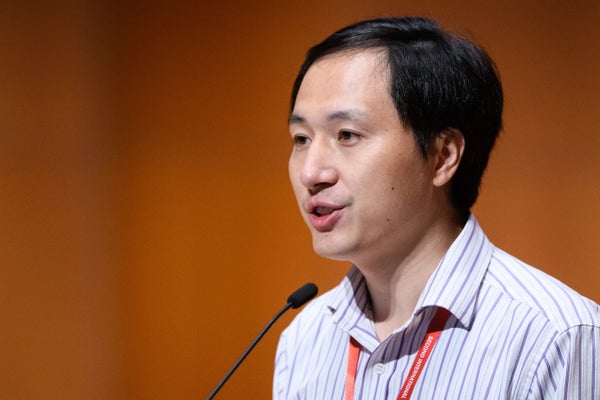
The scientist who announced last year that he had produced the world’s first gene-edited babies has been fired by his university.
The decision, announced on 21 January by the Southern University of Science and Technology in Shenzhen, in China’s Guandong province, follows a report of findings from an investigation into He’s work by provincial health authorities.
A probe by the Guangdong health ministry found that He broke national regulations against using gene-editing for reproductive purposes, Chinese state media agency Xinhua reported on 21 January.
On supporting science journalism
If you're enjoying this article, consider supporting our award-winning journalism by subscribing. By purchasing a subscription you are helping to ensure the future of impactful stories about the discoveries and ideas shaping our world today.
The investigation also found that He’s experiment ran counter to national regulations forbidding people with HIV from using assisted reproduction—an allegation reported for the first time in the Xinhua article. To circumvent the regulations, the article says, He got blood from HIV-negative volunteers.
He provoked international outcry last November when he revealed that he had used the gene-editing technique CRISPR–Cas9 to modify human embryos in an effort to make them resistant to HIV; the embryos were then implanted into a woman and produced twin girls, Nana and Lulu, in November.
According to the investigation’s findings, He is fully to blame for the gene-editing project, and flouted regulations and deliberately evaded oversight in pursuit of “fame and fortune”. He did not respond to Nature’s requests for comment.
Ministry investigation
The Xinhua article was based on an interview with a member of the investigation team from the Guangdong health ministry, which had been tasked by the national health ministry to examine the He affair. It does not mention any punishable crimes, but says that police might now get involved.
The Xinhua article confirms many details of the case for the first time: starting in June 2016, it says, He put together a team that, from March 2017, recruited eight couples consisting of an HIV-positive father and an HIV-negative mother. He’s team edited the genes of embryos from at least two couples. (The Xinhua article does not specify what type of gene editing was done, although He claims that the embryos were edited to remove a gene that enables HIV to enter cells.) In addition to the woman who already gave birth, one other woman involved in the experiment is currently pregnant with a gene-edited embryo. Five other couples are not pregnant, the article reports, and one couple dropped out of the experiment.
The article says that He’s gene-editing activities were “clearly prohibited by the state”, but it doesn’t mention which specific laws or regulations the researcher broke.
The article reports that He and others implicated in the case will be dealt with seriously, and that individuals suspected of crimes will be handed over to the police.
China’s education ministry announced that, in the wake of the Guangdong team’s conclusions, it will collaborate with other ministries and departments to build a better regulatory system for overseeing science, and that it will improve the ethical review of scientific projects.
This article is reproduced with permission and was first published on January 22, 2019.