
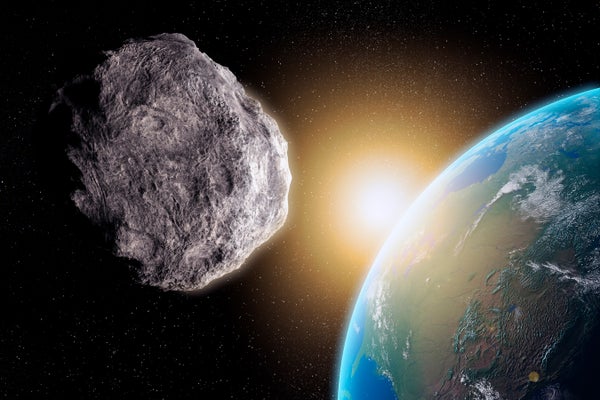
A blast of X-rays from a nuclear explosion should be enough to save Earth from an incoming asteroid, according to the results of a first-of-its-kind experiment.
The findings, published on September 23 in Nature Physics, “showed some really amazing direct experimental evidence for how effective this technique can be”, says Dawn Graninger, a physicist at Johns Hopkins University Applied Physics Laboratory in Laurel, Maryland. “It’s very impressive work.”
Nathan Moore, a physicist at Sandia National Laboratories in Albuquerque, New Mexico, and his colleagues designed the experiment to simulate what might happen if a nuclear bomb was detonated near an asteroid. Previously, scientists have studied the momentum of a bomb’s shock wave — which results from the expansion of gas — pushing against an asteroid. However, Moore’s team says that the huge amount of X-rays produced in the explosion would have a bigger effect in changing an asteroid’s trajectory.
On supporting science journalism
If you're enjoying this article, consider supporting our award-winning journalism by subscribing. By purchasing a subscription you are helping to ensure the future of impactful stories about the discoveries and ideas shaping our world today.
The team used Sandia’s vast Z machine, which uses magnetic fields to produce high temperatures and powerful X-rays, to fire X-rays at two mock asteroids about the size of coffee beans. “About 80 trillion watts of electricity flow through the machine at about 100 billionths of a second,” says Moore. “That intense electrical surge compresses argon gas into a very hot plasma millions of degrees in temperature, and that emits a bubble of X-rays.”
Cut and thrust
The two mock asteroids were about 12 millimetres and made of quartz and silica, to reflect different compositions of asteroids in the Solar System. Each was hung by a thin piece of foil inside a vacuum. When the X-ray bubble hit, it cut the foil like a pair of X-ray scissors and put the asteroids into free fall. That allowed the true impact of the X-rays in conditions simulating the vacuum of space to be observed. “That is completely novel,” says Graninger. “I’ve never heard of that being done before.”
The results of the experiment, which lasted just 20 millionths of a second, showed that the quartz and silica samples were accelerated to 69.5 metres per second and 70.3 metres per second, respectively, before being vaporized. The cause of the acceleration was the X-rays vaporizing the surface of the asteroids, creating thrust as gas expanded away from their surfaces.
Moore says the results show that the technique could be scaled up to much larger asteroids, as big as around 4 kilometres in diameter, to push them away from a collision course with Earth. “In particular, we’re interested in the largest asteroids with a short warning time,” he says. Where these are concerned, other approaches, such as ramming a spacecraft into an asteroid — as NASA’s Double Asteroid Redirection Test, or DART, did in 2022 — “might not have enough energy to knock it off course”.
Mary Burkey, a physicist at Lawrence Livermore National Laboratory in Livermore, California, says the paper is “one of the first big blockbuster publications of trying to figure out on Earth how we can recreate how a nuclear deflection of an asteroid might go”. She notes that other experiments are investigating the possibility, including those using samples of meteorite to more closely mimic the composition of asteroids. “Planetary defence is having a lot more time in the Sun,” she says.
Moore hopes to perform more experimental tests of the X-ray-deflection technique to refine its effectiveness. One day, there might also be a test in space, similar to the DART mission, to see the effect on a real asteroid. “There’s nothing preventing us other than the desire to do that,” he says.
This article is reproduced with permission and was first published on September 23, 2024.