
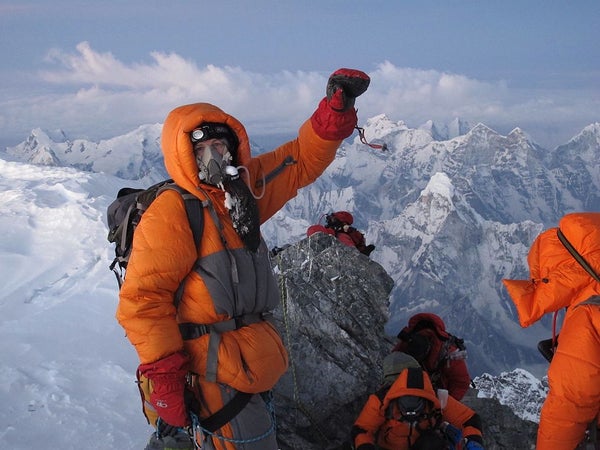

High-altitude pulmonary edema (HAPE), a life-threatening condition that can occur when people ascend a mountain too quickly, has puzzled scientists for years. It causes fluid retention in the lungs, and sufferers, who cough up blood at times, are often unable to walk or sleep. Now a team of scientists may have found the cause and a possible remedy. Their findings appear in the current issue of Circulation: Journal of the American Heart Association.
The researchers examined 16 climbers who had previously experienced HAPE and 14 who had not. They placed catheters in the subjects' pulmonary arteries¿which take blood from the heart to the lungs¿to measure blood pressure. They also gauged the permeability of the pulmonary capillaries. Their goal was testing a common belief that HAPE results when the lower air pressure at high altitudes causes lung capillaries to swell or when the capillaries begin to leak as a result of inflammation. The researchers examined the subjects at a low altitude of 490 meters and then at 4,559 meters 24 hours later.
"We could not find any signs of inflammation," lead author Marco Maggiorini, a physician at the University of Zurich in Switzerland, says. "We did find elevated pressure in the capillaries, which leads to water in the lungs, or pulmonary edema." It turned out that subjects who had experienced HAPE had higher average pulmonary artery pressure and capillary pressure than those who had never developed the condition. The team also found that among those susceptible to HAPE, the ones who actually developed HAPE all had higher pulmonary capillary pressures than the rest.
On supporting science journalism
If you're enjoying this article, consider supporting our award-winning journalism by subscribing. By purchasing a subscription you are helping to ensure the future of impactful stories about the discoveries and ideas shaping our world today.
Based on these findings, Maggiorini suggests that pulmonary edema can be treated with vasodilators to lower pulmonary capillary pressures. "The condition is strictly related to a lack of oxygen in the air when climbers or hikers reach certain altitudes," he explains. "As soon as you give oxygen or a vasodilator, the pressure goes down."