
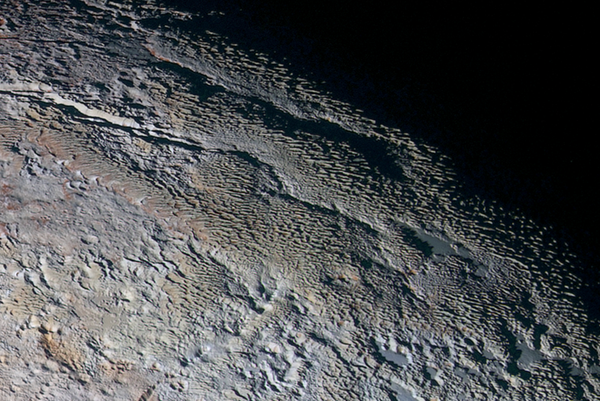

Pluto's surface hosts blades of ice that soar to the height of skyscrapers — and researchers have narrowed down exactly how the dramatic features form.
According to new research, the blades are made mostly of methane ice, and form similarly to (much shorter) spikes of snow and ice on Earth.
When the New Horizons spacecraft flew by Pluto in July 2015, researchers observed an astonishing variety of terrains across the dwarf planet. Flat and cratered areas on the dwarf planet's surface point to its varied geological activity, composition and evolution over time.
On supporting science journalism
If you're enjoying this article, consider supporting our award-winning journalism by subscribing. By purchasing a subscription you are helping to ensure the future of impactful stories about the discoveries and ideas shaping our world today.
The jagged spikes targeted in this latest study form at the highest altitudes on Pluto's surface, near its atmosphere, where methane is able to freeze out of the atmosphere — skipping straight from solid to gas without ever becoming liquid. When the climate is a bit warmer, parts of the methane ice sublimate away, heading straight back to gas form, according to the new study.
"When we realized that bladed terrain consists of tall deposits of methane ice, we asked ourselves why it forms all of these ridges, as opposed to just being big blobs of ice on the ground," Jeffrey Moore, a New Horizons team member and lead researcher on the new work, said in a statement. "It turns out that Pluto undergoes climate variation and sometimes, when Pluto is a little warmer, the methane ice begins to basically 'evaporate' away."
On Earth, such structures are called penitentes, and stretch just a few meters in height in high-altitude regions along the planet's equator. Slight irregularities can turn into dramatic spikes of snow as the structures' surfaces concentrate sunlight toward certain regions, sublimating some parts faster than others and leading to longer and spikier forms.
The presence of penitentes on Pluto tell researchers more about how its surface and air temperature change over time, according to the statement, and the link between methane's presence and high elevations can help researchers map the dwarf planet's topography in places where they have lower-resolution views.
The new work will appear in an upcoming issue of the journal Icarus.
Email Sarah Lewin at slewin@space.com or follow her @SarahExplains. Follow us @Spacedotcom, Facebook and Google+. Original article on Space.com.
Editor's Recommendations
Copyright 2017 SPACE.com, a Purch company. All rights reserved. This material may not be published, broadcast, rewritten or redistributed.