
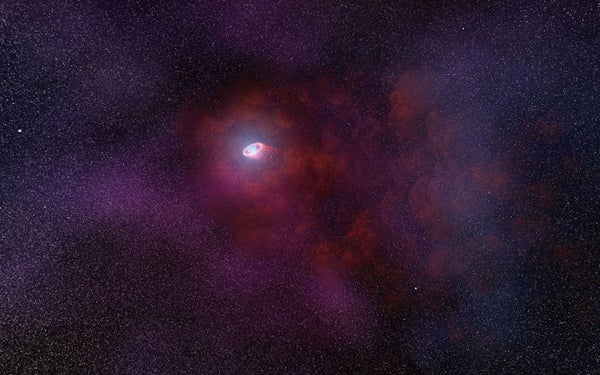
At the center of the Milky Way, there might lie a pulsar—a highly magnetized, spinning neutron star that formed from the dead husk of a massive star that had gone supernova. If confirmed, the possible discovery, which was announced in a paper published on Monday, could reveal new physics.
Pulsars are the universe’s lighthouses. As they spin, they emit steady and predictable bursts of radiation. In turn, researchers can use these rhythmic pulses to reveal tiny changes in spacetime and detect gravitational waves caused by large, massive objects—including supermassive black holes. The discovery of a pulsar near the Milky Way’s central supermassive black hole, Sagittarius A*, could prove invaluable to astronomers as they seek to understand this cosmic behemoth, according to the researchers behind the possible finding.
“Any external influence on a pulsar, such as the gravitational pull of a massive object, would introduce anomalies in this steady arrival of pulses, which can be measured and modeled,” said Slavko Bogdanov, an associate research scientist at Columbia University and a co-author of the study, in a statement.
On supporting science journalism
If you're enjoying this article, consider supporting our award-winning journalism by subscribing. By purchasing a subscription you are helping to ensure the future of impactful stories about the discoveries and ideas shaping our world today.
“If confirmed, it could help us better understand both our own Galaxy, and General Relativity as a whole,” said Karen Perez, a postdoctoral fellow at the SETI Institute and lead author of the paper, in the same statement.
The “intriguing” candidate pulsar, which researchers have called BLPSR, has a rotational period of 8.19 milliseconds, making it especially fast-spinning. “Further tests and observations are necessary to conclusively confirm or reject BLPSR as a pulsar,” the authors wrote in the paper.