Scientists Solve Star Spin Mystery

Magnetic fields help to explain why some stars are spinning more slowly than astronomers thought they should

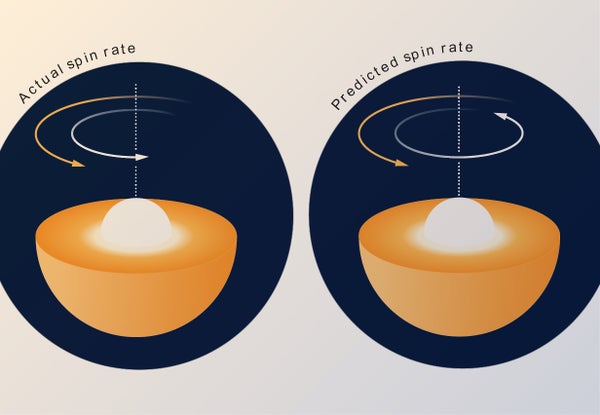
Graphic shows a star's actual and predicted spin rates with the core spinning slower in the actual scenario.

Lucy Reading-Ikkanda

Join Our Community of Science Lovers!

Astronomers can measure how fast stars spin by observing “starquakes”—seismic tremors that are the equivalent of earthquakes on our planet. Yet these observations have posed a puzzle because many stars seem to be spinning slower than they should be. In a new study, researchers modeled how a magnetic field could grow in the internal layers of a star, dragging its rotation down.

Many stars' cores contract at some point, especially toward the ends of their lives when they have ceased fusing hydrogen in their centers. Usually this contraction would speed up a star's spin, just as figure skaters will twirl faster when they pull their arms in. Concentrating more mass in a smaller space will force an object to speed up to preserve angular momentum.

Credit: Lucy Reading-Ikkanda


On supporting science journalism

If you're enjoying this article, consider supporting our award-winning journalism by subscribing. By purchasing a subscription you are helping to ensure the future of impactful stories about the discoveries and ideas shaping our world today.


But the actual spin rate of many stars is slower than theory predicts, particularly in old stars.

Credit: Lucy Reading-Ikkanda

In a new numerical model, researchers found that a small, random magnetic field inside the radiative layer of a star could be amplified by the plasma's flow. Once strong enough, this magnetic field spurs turbulence in the star's plasma, which in turn strengthens the magnetic field, which boosts the turbulence, and so on.

Credit: Lucy Reading-Ikkanda

This magnetic force exerts a powerful torque on the star's plasma, slowing its spin. “It causes a braking effect,” says Florence Marcotte, a scientist at Côte d'Azur University in France, who co-authored the study published in Science.

Credit: Lucy Reading-Ikkanda; Source: “Spin-Down by Dynamo Action in Simulated Radiative Stellar Layers,” by Ludovic Petitdemange, Florence Marcotte and Christophe Gissinger, in Science, Vol. 379; January 20, 2023 (reference)

This mechanism is compatible with observations of the spin rates of neutron stars and white dwarfs. It could possibly occur within the sun's radiative zone as well.

Credit: Lucy Reading-Ikkanda

Clara Moskowitz is chief of reporters at Scientific American, where she covers astronomy, space, physics and mathematics. She has been at Scientific American for more than a decade; previously she worked at Space.com. Moskowitz has reported live from rocket launches, space shuttle liftoffs and landings, suborbital spaceflight training, mountaintop observatories, and more. She has a bachelor’s degree in astronomy and physics from Wesleyan University and a graduate degree in science communication from the University of California, Santa Cruz.

More by Clara Moskowitz

Lucy Reading-Ikkanda is a scientific information designer, art director, and illustrator based in Bedford, New York.

More by Lucy Reading-Ikkanda
Scientific American Magazine Vol 328 Issue 6This article was published with the title “Star Spin Mystery” in Scientific American Magazine Vol. 328 No. 6 (), p. 88
doi:10.1038/scientificamerican0623-88

It’s Time to Stand Up for Science

If you enjoyed this article, I’d like to ask for your support. Scientific American has served as an advocate for science and industry for 180 years, and right now may be the most critical moment in that two-century history.

I’ve been a Scientific American subscriber since I was 12 years old, and it helped shape the way I look at the world. SciAm always educates and delights me, and inspires a sense of awe for our vast, beautiful universe. I hope it does that for you, too.

If you subscribe to Scientific American, you help ensure that our coverage is centered on meaningful research and discovery; that we have the resources to report on the decisions that threaten labs across the U.S.; and that we support both budding and working scientists at a time when the value of science itself too often goes unrecognized.

In return, you get essential news, captivating podcasts, brilliant infographics, can't-miss newsletters, must-watch videos, challenging games, and the science world's best writing and reporting. You can even gift someone a subscription.

There has never been a more important time for us to stand up and show why science matters. I hope you’ll support us in that mission.

Thank you,

David M. Ewalt, Editor in Chief, Scientific American

Subscribe