
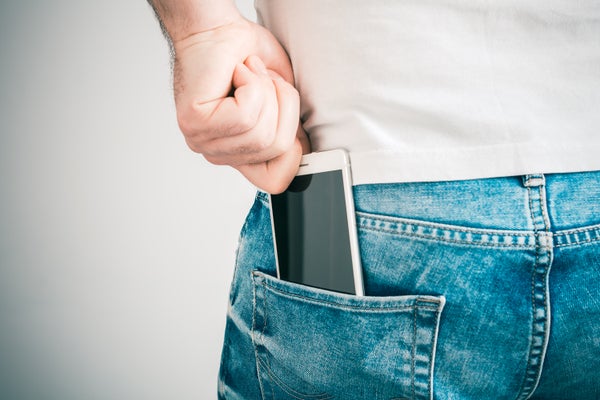
My dependence on devices reached an embarrassing low recently. As I hurried to leave for work one morning, I patted my back pocket and realized I did not have my phone. Seconds later, in a fully automatic behavioral response, I patted my back pocket again, this time reaching for my phone in order to help find my phone. Shame washed over me as I realized the thought process I had just went through: “I don’t know where my phone is! I’ll just get my phone to help me find it.”
This unfortunate incident reveals two important aspects of what new research has called “nomophobia” (or, no-mobile-phone-phobia): (1) the feelings of anxiety or distress that some people experience when not having their phone (“I don’t know where my phone is!), and (2) the degree to which we depend on phones to complete basic tasks and to fulfill important needs such as learning, safety and staying connected to information and to others (“I’ll just get my phone to help me”). Smartphones have increasingly become the tool we use to navigate and organize our daily lives. From keeping our calendars, getting directions, and communicating instantly with others, to helping us answer any questions we might possibly have about the state of our world or the people in it, our dependence on devices is clearly increasing.
This dependence has important psychological consequences. For example, research on transactive memory finds that when we have reliable external sources of information about particular topics at our disposal, then this reduces our motivation and ability to acquire and retain knowledge about that particular topic. In other words, if my wife is an expert on tennis statistics then I will be worse at remembering facts about tennis, since I know I can always ask her. In the past, the primary sources of information on which we could depend to outsource our knowledge have been other people. But now we have a source of near omniscience in our pockets. Why bother remembering anything when you can always just ask Siri? Indeed, this research finds that when it comes to the acquisition and retention of information, our brains treat our devices like relationship partners. So perhaps it is not surprising that we should experience such distress when this relationship is lost because your partner has slipped out of your pocket and on to the movie theater floor.
On supporting science journalism
If you're enjoying this article, consider supporting our award-winning journalism by subscribing. By purchasing a subscription you are helping to ensure the future of impactful stories about the discoveries and ideas shaping our world today.
It’s hard to study a phenomenon like nomophobia, though, if you don’t have a good measurement of it. This is what researchers at Iowa State University tried to create in a recently published paper: they designed and validated a 20-question measure called the Nomophobia Questionnaire (or NMP-Q). The questions on the NMP-Q were developed first by interviewing undergraduates and asking them questions about their thoughts and feelings regarding their devices (e.g. For what purposes do you usually use your smartphone?,How would you feel if you left your smartphone at home and had to spend your day without it?, and Would you feel anxious if you could not use your smartphone for some reason when you wanted to do so?). The researchers coded participants’ responses in these interviews in order to develop the questions that they thought would best represent the idea of nomophobia. This process resulted in the 20-item measure that asked participants to imagine how they would feel if they lost access to their devices. For example, participants indicate the extent to which they would agree with the following statements: I would feel uncomfortable without constant access to information through my smartphone; If I were to run out of credits or hit my monthly data limit, I would panic; I would feel anxious because I could not check my email messages; I would feel nervous because I would not be able to receive text messages and calls.
Participants in a separate study then responded to these items on 1-7 scales ranging from strongly disagree to strongly agree. The researchers calculated NMP-Q scores by simply summing up responses to each item and then categorizing the total score as either “mild nomophobia” (scores of 21-59), “moderate nomophobia” (scores of 66-99), or “severe nomophobia” (scores ≥ 100). Analysis of these data also led researchers to identify four components of nomophobia: (1) not being able to communicate with people, (2) losing connectedness in general, (3) not being able to access information, and (4) giving up on convenience. These represented reliably distinct concerns that all contributed to participants’ general distress over not having their mobile devices.
Before you start taking this test or administering it to friends and family, remember that this research has only developed and validated the scale. No work has yet investigated what other kinds of psychological variables correlate with the NMP-Q. And maybe it’s not all that bad. Maybe the nomophobic have higher quality relationships. Maybe the nomophobic have greater life satisfaction. Maybe they have more successful professional lives.
Or maybe I should admit this is wishful thinking and try to detach from my device for a while.