
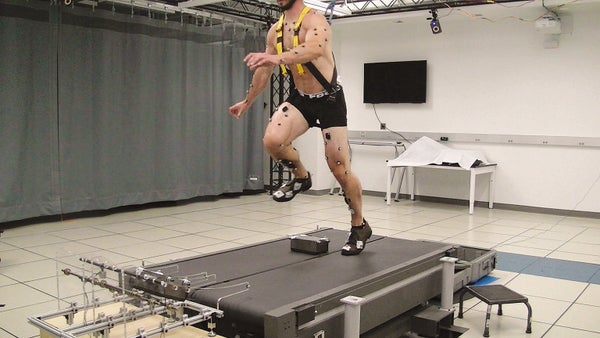
A study participant walks briskly on a treadmill, video cameras recording his every move, when a 35-pound metal block suddenly appears in his path. Special eyeglasses prevent him from seeing it, and he stumbles, lurching forward—until he is caught by a safety harness. One trip down, dozens more to go.
Researchers developed the treacherous treadmill to study how people regain their footing after tripping. They knew this usually means taking an exaggerated step that allows the central nervous system to reorient the body's center of gravity above firm footing, says Michael Goldfarb, a mechanical engineer at Vanderbilt University and co-author of the treadmill study. But “the way you do that changes depending on what your [body's] configuration was when you stumbled,” Goldfarb adds.
People with prosthetic legs often struggle to recover from a stumble and thus fall at far higher rates than the general population. Understanding how people trip and recover on two legs could help researchers design better prosthetics.
On supporting science journalism
If you're enjoying this article, consider supporting our award-winning journalism by subscribing. By purchasing a subscription you are helping to ensure the future of impactful stories about the discoveries and ideas shaping our world today.
To trigger genuine tripping, researchers had to deliver the heavy blocks surreptitiously. Goldfarb and his colleagues' apparatus, described in June in the Journal of NeuroEngineering and Rehabilitation, works because it can place a heavy block on the treadmill so delicately that participants do not perceive it until they have already tripped. An algorithm determines where to place the block so the researchers can observe stumble responses at different points in a subject's gait.
The surprise is key, but participants in this kind of study know they will eventually be tripped up—which could confound results, says Mark Grabiner, a biomechanicist at the University of Illinois at Chicago, who was not involved in the new work. Researchers have taken various approaches to this problem in the past, sometimes not even telling participants they are in a tripping study, Grabiner says. The new study's stealthy design is “an incremental improvement over existing technologies”—a step in the right direction—he adds.
In the next phase of the study, Goldfarb says, his team will use the tripping data to program reflexive stumble responses for a variety of situations in prosthetic limbs.