
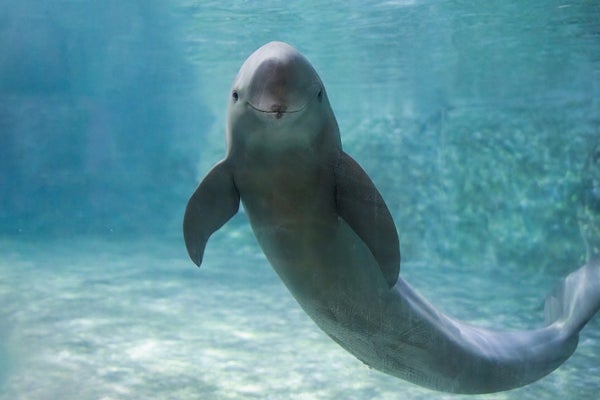
Around 1765, Chinese emperor and poet Qianlong was sailing on the Yangtze River toward the eastern city of Zhenjiang when he encountered a breathtaking sight: a group of what we now call Yangtze finless porpoises (Neophocaena asiaeorientalis asiaeorientalis) emerged from the water’s surface.* “Porpoises chased moonlight on silvered tides, as dragons summoned storm-clouds loom in sight,” he wrote in a poem that was later published in the Imperial Collection of Poems, Volume II.
Almost 300 years later, scientists wanted to chart the historical range of this critically endangered, bulbous-headed cetacean—so they combed hundreds of ancient Chinese poems to seek mentions of it, hoping to map its historical distribution and thus better understand threats to this fragile subspecies. Found exclusively in China’s Yangtze River, it is the world’s only freshwater porpoise. About 1,250 individuals are left in the wild.
“Having access to past data allows us to detect when declines began and correlate those changes with potential threats like habitat destruction, climate change, overhunting, disease or the introduction of invasive species,” says Yaoyao Zhang, an ecologist at the Institute of Hydrobiology, Chinese Academy of Sciences.
On supporting science journalism
If you're enjoying this article, consider supporting our award-winning journalism by subscribing. By purchasing a subscription you are helping to ensure the future of impactful stories about the discoveries and ideas shaping our world today.

A Ming Dynasty woodblock-printed illustration from Sancai Tuhui (in English, Compendium of the Three Powers), a 49-volume book of poems on birds and animals compiled by Wang Qi (1573–1620). This poem meticulously documents the Yangtze finless porpoise through morphological details, surfacing postures and maternal care behaviors.
Sancai Tuhui, compiled by Wang Qi (1573–1620) (CC BY-SA)
Zhang and her colleagues turned to ancient poems because official records rarely mentioned these animals. Using an online database of Chinese literature, “we searched for various historical names of the Yangtze finless porpoise across dynastic poetry, manually verifying each mention to ensure it referred to the porpoise and not other animals,” Zhang says.
“The poets vividly described the actual behaviors of the porpoises [using language] such as ‘blowing waves...,’ ‘surging waves ...’ and ‘bowing to the wind,’” she adds.
The research, published on Monday in Current Biology, revealed 724 poems that mentioned the porpoises. Half contained information about where they were seen.
This window into the past revealed that the porpoises’ range has decreased by around 65 percent over 1,400 years, with an accelerated decline in the past century. Poems from the distant past mentioned these animals living in tributaries and lakes along the Yangtze, but in more recent poems, these references dramatically decreased. The researchers concluded that the subspecies’ range in these tributaries and lakes has declined by 91 percent.

A Yangtze finless porpoise hunting in Poyang Lake in China.
Yu Huigong
The study “builds on many prior examples on how historical texts of various kinds can help understand past species distributions and, not least, human-caused biodiversity losses,” says Jens-Christian Svenning, a macroecologist at Aarhus University in Denmark, who was not involved with the new research. For example, scientists reconstructed the former composition of fauna in Greece with the aid of descriptions from ancient epic poems. Though there can be challenges to this approach—and sometimes inaccuracies—there’s “certainly much potential” to apply this method to other species and in other areas of the world, Svenning says.
For their next step, Zhang says she and her colleagues are planning to dig back into the poems they have collected to search for information about “what the river looked like in the past, how big the groups of porpoises used to be and how they might have behaved before their numbers dwindled.”
*Editor’s Note (5/6/2025): This sentence was updated after posting to correct the year.