
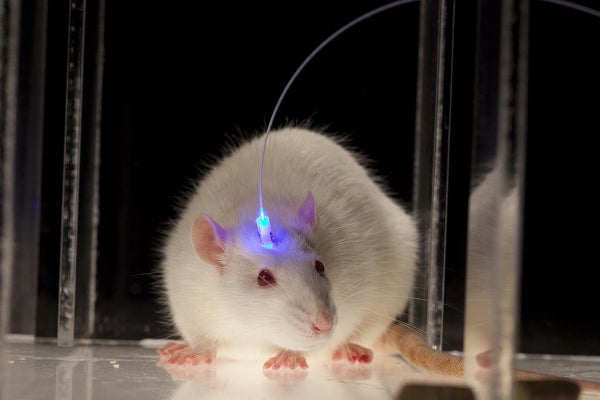
Turning on a set of neurons that dampen brain activity improves social behavior in a mouse model of autism; turning off neurons that excite brain activity does the same thing.
These findings, published today in Science Translational Medicine, add heft to the long-standing theory that autism stems from too much excitation in the brain1. They also hint that treatments that restore the balance between excitation and inhibition could ease social difficulties in people with autism.
“If we could shift something in their brains in just the right way, we might be able to help them with social function,” says lead investigator Karl Deisseroth, professor of bioengineering and psychiatry at Stanford University in California.
On supporting science journalism
If you're enjoying this article, consider supporting our award-winning journalism by subscribing. By purchasing a subscription you are helping to ensure the future of impactful stories about the discoveries and ideas shaping our world today.
The work relies on a technique called optogenetics that Deisseroth’s team pioneered. In this technique, researchers engineer mice to express light-sensitive proteins called opsins. They then shine light into the mice’s brains to turn certain neurons on or off.
Deisseroth’s team has used this technique to ease signs of anxiety, depression and obsessive-compulsive disorder in mice. This is the first time they have used optogenetics to manipulate social behavior in a mouse model of autism.
“I think this work is important because it provides the most direct evidence so far that acutely changing the ratio of excitation to inhibition immediately improves autistic-like behaviors,” says William Catterall, professor of pharmacology at the University of Washington in Seattle, who was not involved in the new study.
Flipping switches:
In 2011, the researchers reported that activating excitatory neurons in the prefrontal cortex, a region involved in social behavior, causes typical mice to lose interest in interacting with other mice. The findings suggested that too much excitation contributes to social difficulties.
In the new study, Deisseroth’s team used mice that lack both copies of CNTNAP2, a gene linked to autism. Unlike typical mice, these mice do not show interest in interacting with an unfamiliar mouse. They are also hyperactive.
The researchers inserted an opsin into interneurons, a type of inhibitory neuron, in the mutant mice’s prefrontal cortex. They then exposed the mice to a flash of blue light, causing the interneurons to fire, and then placed an unfamiliar mouse in the cage.
Instead of largely avoiding the visitor as they ordinarily do, the mutant mice readily approached the new mouse, and spent as much time interacting with it as controls do.
The researchers repeated the experiment — this time using an opsin to turn off excitatory neurons in the prefrontal cortex — and the mice were similarly sociable. Boosting inhibition and turning off excitation also make the mutant mice less hyperactive.
The results are “striking,” says Susanne Ahmari, assistant professor of psychiatry at the University of Pittsburgh. Ahmari was not involved in the study but has previously collaborated with Deisseroth. She says it is unclear whether the mouse findings will extend to people with autism, but the fact that correcting the imbalance instantaneous shifts behavior is encouraging. That suggests that the wiring in the mice’s brain is relatively intact, despite having the mutation.
However, one limitation of the study is that the researchers assessed how mutant mice interact with other mutants, rather than with controls, Ahmari says.
Tuning circuits:
Optogenetics is unlikely to be available for use in people anytime soon. But the study suggests the brain cells and circuits that a drug or other types of treatments should target.
“Once you have causal knowledge — which circuit, which cells, what timing — then any kind of treatment becomes more powerfully enabled,” Deisseroth says.
He and his team also engineered mice so that their inhibitory neurons light up when they fire. They then inserted a fiber-optic probe into the prefrontal cortex to record the flashes of light.
They found that in control mice, activity in this region spikes higher when the mice interact with an unfamiliar mouse than with an object. In the mutant mice, by contrast, the activity spikes equally with another mouse or object.
Mutants and controls show similar spikes in inhibitory activity when interacting with unfamiliar cage-mates, however, so it is unclear how the inhibition relates to their social behavior.
Deisseroth’s team is recording the activity of individual neurons for clues to how they may malfunction during social interactions.
References:
Selimbeyoglu A. et al. Sci. Transl. Med. 9, eaah6773 (2017) Abstract
Further Reading
This story was originally published on Spectrum.