
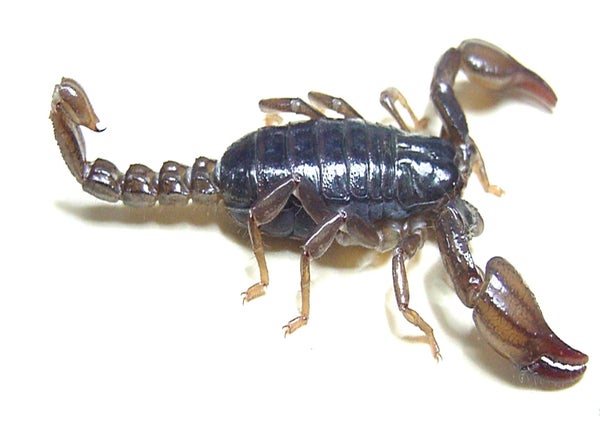
We rarely think of scorpions as beneficial. But researchers have isolated two new compounds in the arachnids' venom that show promise for treating staph infections and drug-resistant tuberculosis.
Scorpion venom is beyond expensive: harvesting a milliliter would cost about $10,300, says Richard Zare, a chemist at Stanford University and senior author of a study published in June in the Proceedings of the National Academy of Sciences USA. He estimates that “milking” venom from one scorpion can yield only a few thousandths of a milliliter at a time at most, and it takes two or more weeks for an individual's supplies to replenish. The substance can still be worth studying, however. Some of its constituent compounds have intriguing medicinal properties and can be synthesized more cheaply in the laboratory.
Researchers at the National Autonomous University of Mexico milked scorpions of the eastern Mexican species Diplocentrus melici, whose venom had never been studied before. They separated its components and tested some on Staphylococcus aureus, Escherichia coli and Mycobacterium tuberculosis bacteria. Two of these components—one of which happens to be red when isolated and the other blue—killed staph and TB microorganisms, suggesting their potential as antibiotics.
On supporting science journalism
If you're enjoying this article, consider supporting our award-winning journalism by subscribing. By purchasing a subscription you are helping to ensure the future of impactful stories about the discoveries and ideas shaping our world today.
The researchers sent small samples of the isolated compounds to Zare's group at Stanford to determine the substances' compositions and molecular structures. The group then chemically synthesized the compounds and shipped them to the Salvador Zubirán National Institute of Medical Sciences and Nutrition in Mexico City.
There pathologists tested the synthesized substances in mice infected with tuberculosis and on human tissue samples hosting staph bacteria. The red compound proved more effective at killing staph, and the blue one worked better on TB—including a drug-resistant strain—without damaging the lining of the mice's lungs.
Christine Beeton, a molecular physiologist and biophysicist at Baylor College of Medicine, who studies therapeutic uses for venom but was not involved with the new work, says the study's approach seems promising. But she cautions that the compounds still need to be tested in larger animals—and they could also be challenging to synthesize on the scales required for testing in humans.