
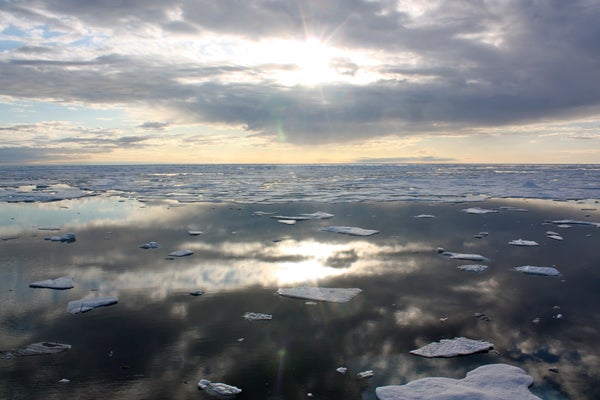
A light winter snow fell on Barrow, Alaska, this week as scientists reported that the ice cover off Barrow’s Arctic shores had declined to its second-lowest level in satellite history, tied with 2007.
The National Snow and Ice Data Center in Colorado reported yesterday that 1.6 million square miles of ice covered the Arctic Ocean on Saturday.
As a result, Alaska’s Beaufort and Chukchi seas contain unusually large patches of ice-free waters. Canada’s southern Northwest Passage routes also appear to be open, although some ice was reported in Russia’s Northern Sea route, scientists said.
On supporting science journalism
If you're enjoying this article, consider supporting our award-winning journalism by subscribing. By purchasing a subscription you are helping to ensure the future of impactful stories about the discoveries and ideas shaping our world today.
According to satellite records begun in 1978, the lowest levels of Arctic ice ever recorded occurred in 2012, when the polar ice cap shrunk to roughly 1.3 million acres.
Scientists note that although this year’s Arctic ice cover appears to be growing as winter approaches, a new round of melting is still possible if the region is hit by changing winds or a late-season melt.
This summer’s low ice levels follow the winter of 2015-2016, which saw record low levels of Arctic ice. Data center researchers reported that maps of sea ice age indicate that the ice pack in March was much thinner than normal.
From March into June, the Arctic ice maximum extent hit record lows. However, July and August saw stormy, cool and cloudy conditions. The ice melt accelerated again early this month when the region was hit by a series of storms along Alaska’s northern shores.
“The record makes it clear that the ice is not rebounding to where it used to be, even in the midst of the winter,” Claire Parkinson, main author of the study and a senior climate scientist with NASA’s Goddard Space Flight Center in Greenbelt, Md., explained in a statement.
The low Arctic sea ice conditions are bad news for hunters and whalers in Barrow and other Native villages in Alaska that rely on subsistence hunting. They traditionally build ice camps far from shore to reach remote populations of migrating marine life.
Ocean Conservancy President Janis Searles Jones noted that the lack of sea ice also hurts polar bears and other wildlife that live on the coastal ice floes.
“The loss of summer sea ice also opens up the Arctic to increasing vessel traffic and the risks that come with it like higher risk of oil spills, impact of noise pollution on marine wildlife and the introduction of invasive species,” Jones said in a statement.
Reprinted from ClimateWire with permission from Environment & Energy Publishing, LLC. E&E provides daily coverage of essential energy and environmental news at www.eenews.net. Click here for the original story.
