
Norfolk, Va., is half a world away from Antarctica's melting ice sheets. Yet this low-lying city on the Chesapeake Bay is one of the places most vulnerable to tidal flooding from rising sea levels in the U.S. As the climate heats up, in the most extreme scenario Norfolk and other East Coast communities can expect waters to climb as much as 11.5 feet—about 3.5 feet more than the global average—by 2100.
This year the National Oceanic and Atmospheric Administration released a report aiming to help local governments such as Norfolk's get ready. It is the first analysis to break down vulnerability into one-degree chunks of latitude and longitude—about 70 miles across—for the entire U.S. coastline, and it lays out possible scenarios for average global sea-level rise from “low” (a rise of 0.3 meter, or about one foot) to “extreme” (2.5 meters, or about eight feet). It also accounts for local factors such as subsidence, or sinking land. In nearly all the scenarios, rises in the Northeast and the western Gulf of Mexico exceed the worldwide average.
“We wanted to say, 'Listen, here are the main factors, and here's how they could affect you,' so that everyone has the best available data and the same models to use in the same manner across the coastline,” says NOAA oceanographer William Sweet, the report's lead author.
On supporting science journalism
If you're enjoying this article, consider supporting our award-winning journalism by subscribing. By purchasing a subscription you are helping to ensure the future of impactful stories about the discoveries and ideas shaping our world today.
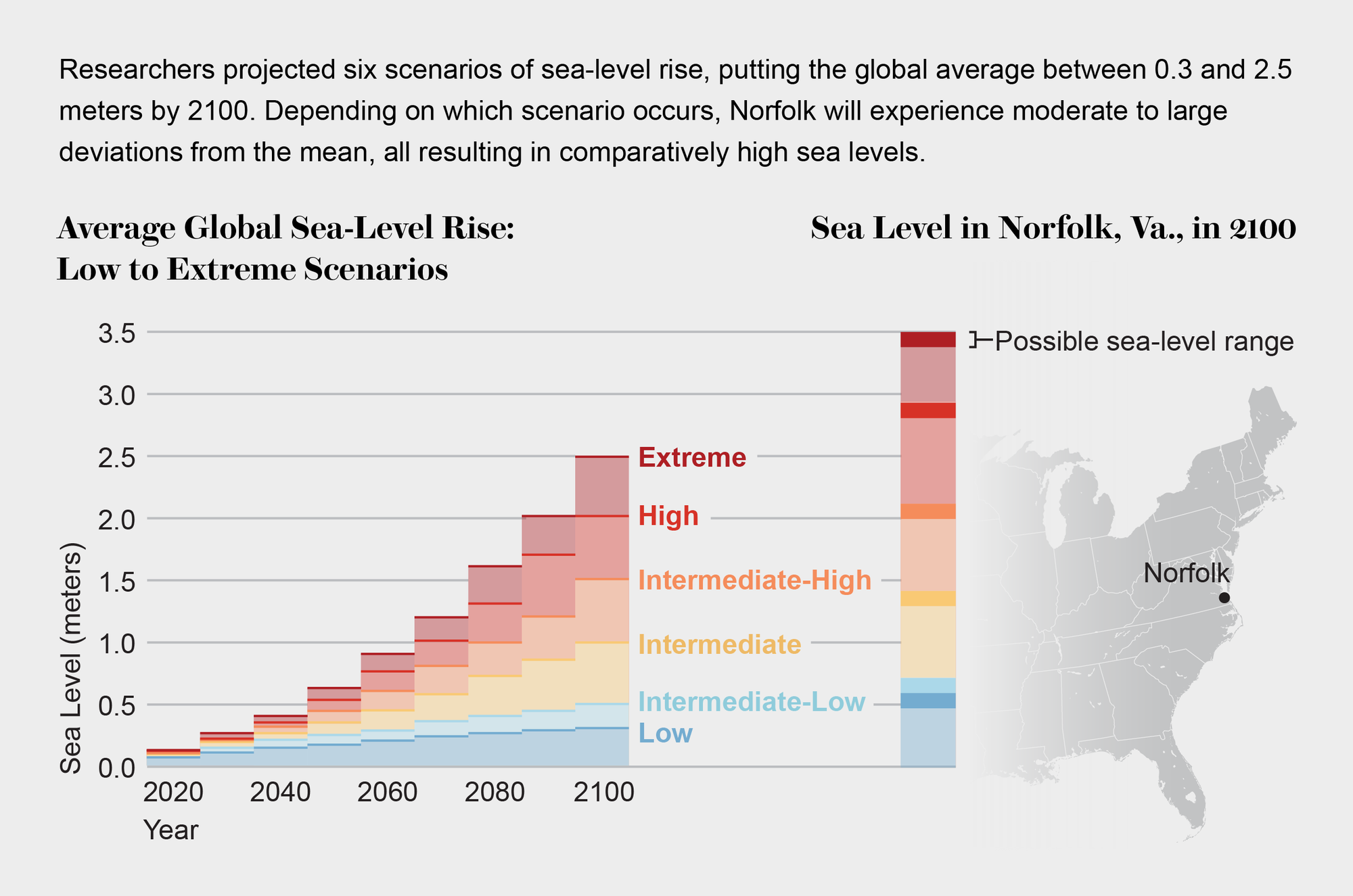
Credit: Amanda Montañez; Source: Global and Regional Sea Level Rise Scenarios for the United States, by William V. Sweet et al. National Oceanic and Atmospheric Administration; January 2017
To understand why the East Coast is particularly vulnerable, one has to look southward. Antarctica's ice sheets are melting faster than initial models predicted, and ocean currents sweep that water northward. Gravity is also to blame: Antarctica's tremendous mass exerts a huge pull on the oceans, extending all the way to the Atlantic—but as the continent loses ice, its grip will weaken, allowing that closely held water to flow toward the opposite pole. Melting mountain glaciers add more water, and higher global temperatures make the oceans warm and swell in a process called thermal expansion.
So-called sunshine flooding—inundation without storms—now occurs in Norfolk as often as nine days a year, up from two days a year in the mid-1980s, the report says. City officials are employing everything from earthen dikes to water-permeable pavement to tame the rising waters.
Authorities along the entire East Coast would do well to start planning for a waterlogged future now, says Larry Atkinson, a professor of oceanography at Old Dominion University in Norfolk, who was not involved in the NOAA report. “Greenhouse gases can be stopped tomorrow,” he says, “and there will still be sea-level rise into the next century.”