
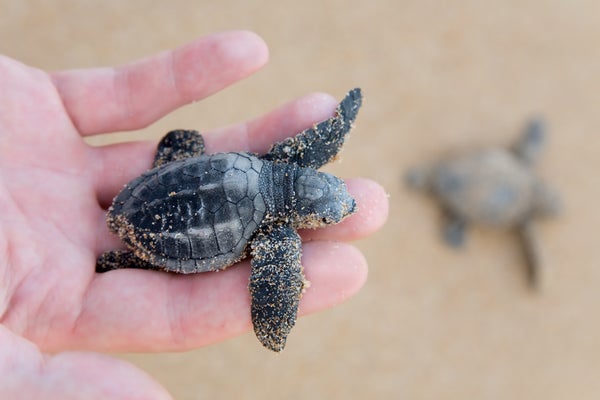
To juvenile loggerhead sea turtles, a tasty squid might as well be a disco ball. When they sense food—or even think some might be nearby—these reptiles break into an excited dance. They tilt their head toward the surface, open their mouth and flap their front flippers in a swim stroke that resembles a doggy paddle. Sometimes they twirl in place like a top.
Researchers recently used this distinctive behavior to test whether loggerheads could identify the specific magnetic field signatures of places where they had eaten in the past. The results, published in Nature, reveal that these rambunctious reptiles dance when they encounter magnetic conditions they associate with food.
According to the study’s lead author, Texas A&M University marine biologist Kayla M. Goforth, the findings show that loggerhead sea turtles can learn locations’ magnetic signatures. This information helps them create a magnetic map akin to a GPS, she says.
On supporting science journalism
If you're enjoying this article, consider supporting our award-winning journalism by subscribing. By purchasing a subscription you are helping to ensure the future of impactful stories about the discoveries and ideas shaping our world today.
Loggerheads and other sea turtles are renowned for their far-ranging migrations, in which they travel thousands of miles without losing track of where they started. Many sea turtles come back to specific foraging grounds year after year, and females often return to lay their own eggs at the same beaches where they hatched.
Scientists have known for decades that sea turtles use Earth’s magnetic field to orient themselves as if they have a built-in magnetic compass. But accurately navigating back to a specific location requires knowing not just the direction in which they are traveling but also the precise coordinates they are heading to. Some scientists have theorized that sea turtles can learn specific magnetic coordinates of foraging grounds and nesting beaches, perhaps sensing factors such as magnetic field intensity.
To put that idea to the test, Goforth and her colleagues collected several loggerhead hatchlings on an island off North Carolina. (The turtles were returned to the wild the following summer.) In the laboratory, the turtles were placed in buckets that were hooked up to a magnetic coil system; running an electric current through the system created a magnetic field in the bucket. The scientists calibrated these fields to replicate the magnetic conditions of various locales along the Eastern Seaboard, such as spots in the Gulf of Mexico or along the coast of Maine.
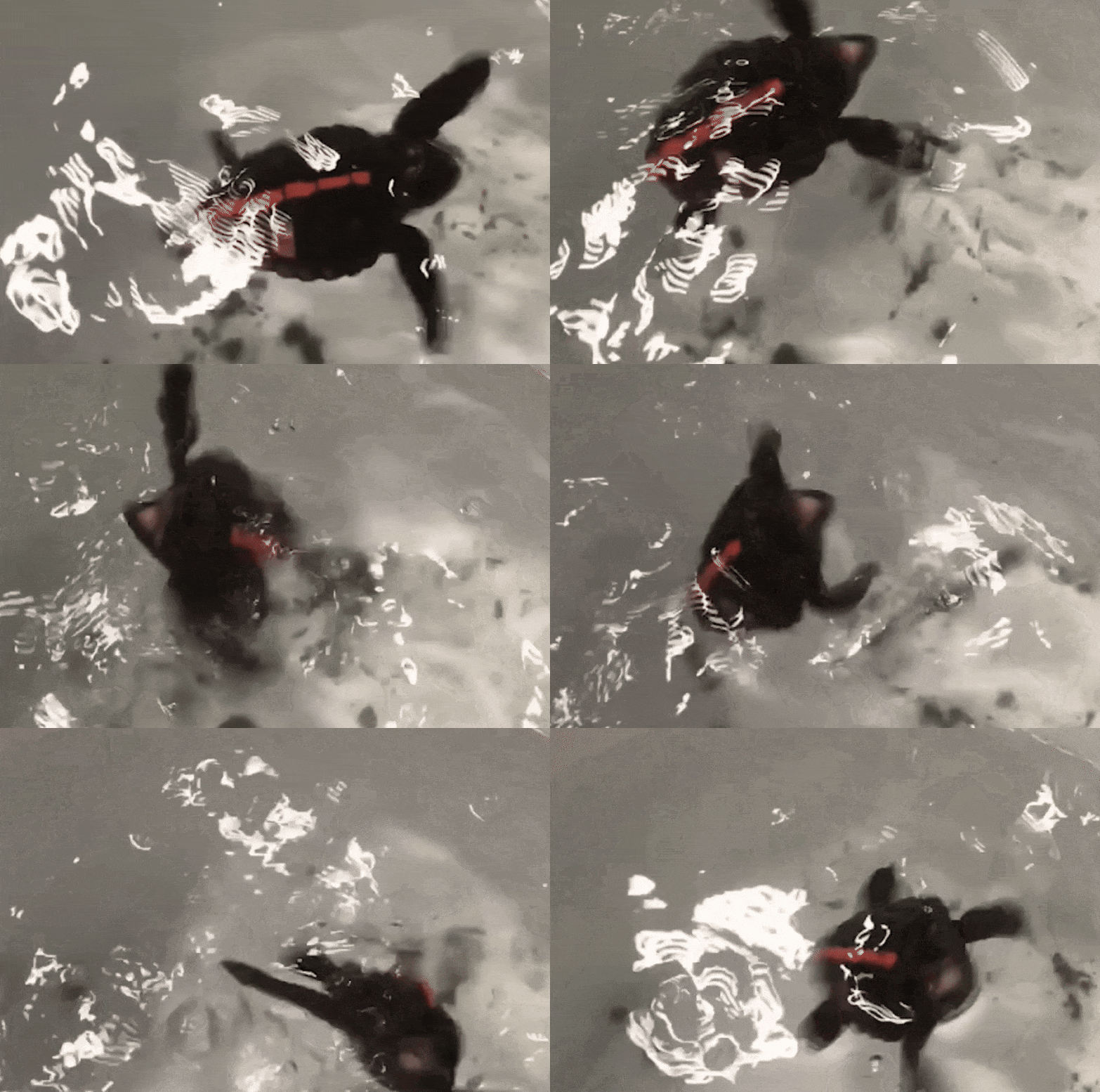
A loggerhead sea turtle "dancing" in response to the magnetic signature of a spot it associates with food.
Goforth et al., Nature (2025)
Each juvenile loggerhead was exposed to two distinct magnetic fields. Over a two-month conditioning period, the turtles spent equal amounts of time in each field—but got food in only one of them. Then, during experimental trials over several consecutive days, the team re-created the two magnetic fields but did not feed the turtles.
The scientists discovered that, even with no food present, the sea turtles displayed their dancing behavior when they encountered the magnetic conditions associated with past feedings. This reaction supports the notion that these animals can learn foraging locations’ magnetic coordinates. A similar ability has been observed in salmon as they venture to and from oceanic feeding grounds. (As to why the turtles dance, Goforth says they just “get really excited in any situation when you’re giving them food like that.”)
The researchers tested the loggerheads again after several months without reexposing them to the two magnetic fields to determine whether the turtles retained these coordinates over a longer period. The animals still danced when they encountered the magnetic conditions associated with food.
According to Goforth, these turtles can probably remember magnetic coordinates for several years or even decades. “In the wild, they retain feeding information from when they are hatchlings to adults, which is a 20-year time span,” she says.
Marine biologist Jeanette Wyneken, who studies sea turtles at Florida Atlantic University and was not involved in the new research, says the ability to learn geomagnetic coordinates emphasizes how crucial food sources are for growing sea turtles. “It’s very important for young sea turtles to outgrow [the size of] predator mouths as quickly as possible,” she says. The turtles “need to efficiently locate food to sustain their development and increase their chances of survival.”
Goforth and her colleagues also wanted to determine whether the sea turtles’ magnetic mapping capabilities were linked to their internal magnetic compass. The researchers ran similar experiments but added radio-frequency waves, which disrupted the animals’ ability to orient themselves via magnetic fields. They discovered that the turtles could still recognize specific magnetic coordinates.
The findings suggest sea turtles possess two distinct senses for detecting magnetic fields—one for sensing direction and one for other magnetic features. Past work has indicated some songbirds and newts also possess dual magnetoreception systems. Because birds and amphibians are only distantly related to sea turtles, Goforth and her colleagues think magnetic compasses and maps might be a common feature in the vertebrate travel toolbox.