
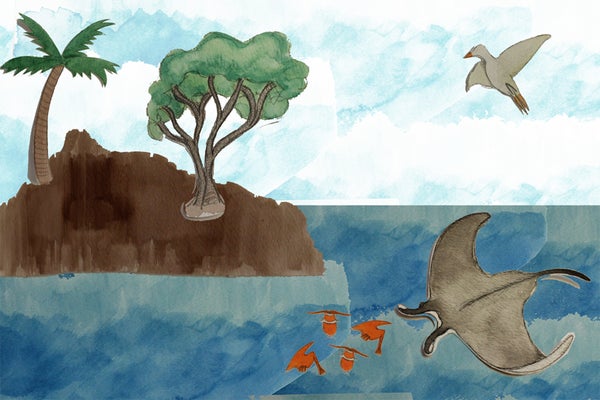
Food webs are all around us, involving everything from the earthworms that turn the soil to the tomato on our hamburgers at dinner. But tracing exactly how one organism affects another isn't always easy. A recent study in Scientific Reports on May 17th chronicles a food web at the Palmyra Atoll in the central Pacific, illustrated in the image above.
The web begins out in the ocean, where seabirds eat squid, fish and other tasty creatures. Those seabirds then fly to Palmyra to make their nests. On the atoll there are native trees and the non-native palm tree. Palm trees are not ideal nesting spots; they move around too much in the breeze and don't have enough nooks to safely rest a nest on. So more birds nest in the native trees. More birds means more droppings, which means richer soil beneath the nests, which runs off into the water nearby and delivers nutrients to the plankton there. Those plankton are the favorite food of manta rays, who come in to feast.
Discovering this food web was a bit of an accident, says Doug McCauley at Stanford University, the paper's lead author. "We happened to be tracking mantas in the lagoons," he says, and noticed that there were far more manta rays in regions near native forests on Palmyra than near the palm trees. From there, McCauley's group traced the effect all the way back to the seabirds.
On supporting science journalism
If you're enjoying this article, consider supporting our award-winning journalism by subscribing. By purchasing a subscription you are helping to ensure the future of impactful stories about the discoveries and ideas shaping our world today.
These long chains are rare to observe in nature, McCauley says. But he wonders if they were always rare or whether human activity has broken many of the long chains before scientists could find them. And it's nearly impossible to discover interactions that are no longer there. "Changes to interactions leave no evidence," McCauley says. "We're talking about important connections in the way this whole system operates, but those connections just don't fossilize."