
Long before the Vikings reached America, and before doomed Portuguese navigator Ferdinand Magellan sailed into the unknown for history’s first circumnavigation of Earth (completed in 1552), a group of spiders was already crossing the oceans and settling faraway lands in the Southern Hemisphere.
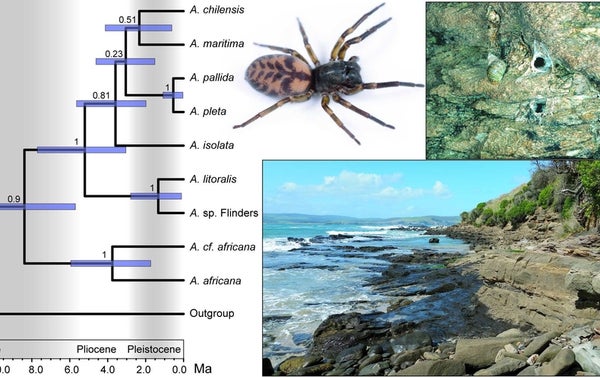
An international team of spider experts, zoologists and biogeographers from Argentina, Switzerland and Australia has reconstructed the incredible adventure of a genus of coastal spiders called Amaurobioides, which has traveled around the world in the last eight million years. Today these ancient explorers can be found in three continental areas: Chile (between La Serena and Puerto Montt), Africa and Australasia. “Ancestors of those spiders, which today live near the sea at the southern end of the continent, departed from South America and arrived in South Africa during the Miocene epoch, about 10 million years ago,” says arachnologist Martin Ramirez, chief of research at the National Scientific and Technical Research Council of Argentina, at the Argentina Museum of Natural Sciences in Buenos Aires. “In South Africa they settled on the coastline and developed the ability to withstand immersion in water, about eight million years ago. From there they dispersed over time, helped by the Antarctic Circumpolar Current (ACC), into Australia and New Zealand, and then came to Chile. This is the first study demonstrating a high level of detail in terms of the transoceanic dispersal of these spiders.”
Until now it was not known whether an ancestral population of this species had arisen in ancient supercontinent Gondwanaland and then moved away from one another when it split—or if the spiders evolved on a single continent and then scattered across the oceans. To solve this mystery, scientists collected 45 specimens of Amaurobioides in South Africa, Australia, Tasmania, New Zealand and Chile. They then analyzed the spiders’ genetic information, reconstructed their evolutionary family tree and explored their movement around the world.
On supporting science journalism
If you're enjoying this article, consider supporting our award-winning journalism by subscribing. By purchasing a subscription you are helping to ensure the future of impactful stories about the discoveries and ideas shaping our world today.
“My job is to figure out how certain species got to be where they are now,” says Sara Ceccarelli, a Swiss biogeographer also at the Argentine Museum of Natural Sciences. “In this case, thanks to genetic analysis, we could determine the age of the species in each area. It was not a single event, but several waves of spiders, enough to establish a viable population.” Spiders are incredibly diverse, and many kinds are innate explorers and conquerors. For example, they are often among the first species to show up on volcanic islands emerging from the oceans.
Amaurobioides spiders are small—between one and 1.5 centimeters in length—and in coastal areas they tend to build tiny cells within rocks, so their homes are not flooded when the water rises. Whereas there are species that travel long distances pushed by the wind, researchers suspect Amaurobioides crossed vast stretches of water floating on matter ranging from algae remains to logs. “They can survive for months without food,” says arachnologist Robert Raven of Queensland Museum in Australia, co-author on this research, which was published in PLoS ONE. And these minuscule explorers did not need an engine or sails—they had the ACC and prevailing winds flowing from west to east in their patient and silent conquest.