
On supporting science journalism
If you're enjoying this article, consider supporting our award-winning journalism by subscribing. By purchasing a subscription you are helping to ensure the future of impactful stories about the discoveries and ideas shaping our world today.
With recordings of electrical signals from the brain and a bit of math, researchers are getting a peek into the minds of the minimally conscious. A team led by scientists at the University of Cambridge and the Medical Research Council Cognition and Brain Sciences Unit in Cambridge, U.K. announced in PLOS Computational Biology on October 16 that they’ve identified brain signatures in a small cohort of seemingly unconscious and unaware patients that appear to be consistent with conscious thought.
To record the electrical brain patterns of 13 patients in a vegetative state—a disorder of consciousness in which a brain-damaged patient is unresponsive or unaware of his or her surroundings—the team pasted 128 electrodes onto each patient’s scalp. They then used a mathematical technique called “graph theory” to translate the recorded electroencephalography (EEG) data into graphs of neural connections.
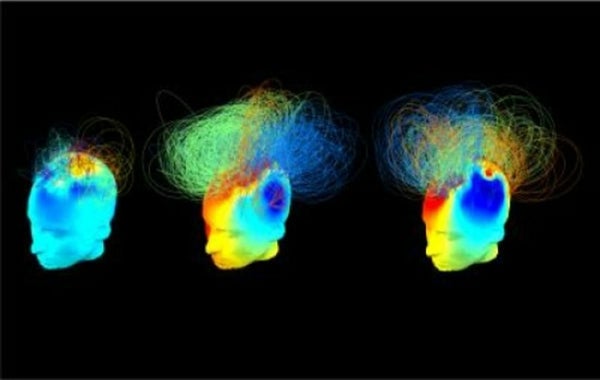
The image shows the results from three individual subjects: the two on the left are vegetative patients who scored similarly on a behavioral test measuring their level of motor, visual and auditory abilities, and the head on the right is a healthy control. The two vegetative patients were operating solely on reflexes—they might have had a fixed stare, moved their eyes randomly, or made unintelligible sounds or movements. The heights of the colored arcs indicate the strength of the neural connections, and each color of the arc represents a different pathway in the brain. The primary-colored splotches on the head show the robustness of the connections from the front of the brain to the back: blue is strong, red is weak and yellow is in between.
The image reveals a striking resemblance between the vegetative patient in the middle and the healthy subject on the right: both have similar, active patterns of electrical activity and connectivity in their brains. This suggests that although the middle patient lacks outward signs of cognitive function, he or she appears to harbor hidden brain signatures that might indicate consciousness.
A separate cognitive test provided further evidence that the middle vegetative patient indeed had more advanced brain activity than the patient on the left. The researchers put the patients into an MRI machine and asked them to imagine themselves playing a game of tennis. While the two patients on the left appeared to be at equal levels of vegetation, the scan revealed that the middle patient could complete the ‘tennis task,’ while the patient on the left could not. This backs up the idea that some patients who seem unresponsive may have brain activity capable of supporting active, conscious thought.
“We’re getting better at using neuroimaging techniques like EEG to understand how the brain generates consciousness,” says Srivas Chennu, a computational neuroscientist at the University of Cambridge who is an author on the paper. “The main takeaway is that we can now see these networks.” In addition to bolstering understanding of the elusive and puzzling brains of minimally conscious patients, Chennu adds, these simple and affordable EEG tests may one day replace the expensive and less widely available MRI scans that doctors currently use to evaluate brain patterns.
—Julia Calderone