
Health officials in Florida announced Thursday that they’re investigating a second case of Zika infection that may have been locally acquired.
The patient is in Broward County, which is adjacent to Miami-Dade County. The first patient, whose case was announced Tuesday and is still under investigation, is a woman living in Miami-Dade.
The Florida Department of Health called the new case “a possible non-travel related case.” The statement did not indicate whether the department believes the two cases may be linked, nor did it give any indication about how far away the two people live from one another.
On supporting science journalism
If you're enjoying this article, consider supporting our award-winning journalism by subscribing. By purchasing a subscription you are helping to ensure the future of impactful stories about the discoveries and ideas shaping our world today.
Florida has asked for help from the Centers for Disease Control and Prevention, which is sending a medical epidemiologist to assist with the investigation.
“CDC has been working with state, local, and territorial health officials to prepare for the possibility of locally acquired Zika infection in the United States,” the CDC said Thursday in a statement.
“Officials from Florida participated in all these activities, and their experience in responding to mosquito-borne diseases similar to Zika, including dengue and chikungunya, has been an important source of knowledge in this effort.”
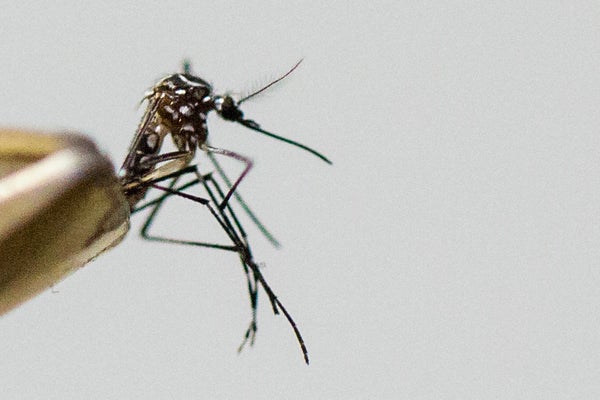
When public health officials have warned about potential transmission of Zika in the US, Florida has been at the top of the at-risk list. The state has Aedes aegypti mosquitoes, a species known to transmit Zika.
And, as the CDC noted, Florida has experience with other viral diseases spread by these mosquitoes.
In 2014, the state had the first US outbreak of chikungunya, which took place in the same part of the state — southeastern Florida. There were about a dozen cases in that outbreak recorded in Miami-Dade, Broward, Palm Beach, and Saint Lucie counties.
Infectious diseases expert Michael Osterholm said given the nature of Aedes aegypti, he suspects these two Zika cases, if locally acquired, may not be linked.
Aedes aegypti bite near where they breed, traveling very short distances over their lifetimes. “From where it’s hatched to where it lives is often just hundreds of yards,” said Osterholm, director of the University of Minnesota’s Center for Infectious Diseases Research and Policy.
“So unless these two people lived in the exact same neighborhood … it really just is an issue of the beginning of the Zika mosquito season in Florida,” Osterholm said.
He suggested people could do a lot to reduce their risk of infection by cleaning up their properties and neighborhoods, ensuring there are no places for the mosquitoes to breed.
“I think these early cases don’t give us a clue yet to the total number of cases that might be found,” he said. “But we shouldn’t be surprised if we have a number of cases. Clearly not hundreds, but we could have 20, 30, 40 cases” between now and September.
Experience with the other diseases spread by Aedes mosquitoes suggests aspects of the American lifestyle — air-conditioning in many homes and cars, the use of screens to cover doors and windows — could protect against the really large Zika outbreaks being seen in many parts of Latin America.
If confirmed, the Florida cases will be the first known instances where Zika infection was acquired in the US from mosquitoes. There have been 15 recorded cases of sexual transmission of the virus in the US and one laboratory worker was infected in a lab accident.
New figures posted by the CDC on Thursday show that as of July 20, 1,403 travel-related cases of Zika infection have been detected in the US. Of those, 400 have been pregnant women. Twelve infants with Zika-related birth defects have been born in the US so far, the agency reported. Another six affected pregnancies were lost, either to stillbirth, miscarriage, or termination.
Florida has reported 334 travel-related Zika cases, 46 of them pregnant women.
So far, there is no confirmed case of local mosquito transmission of the virus; the Florida patients would be the first.
Republished with permission from STAT. This article originally appeared on July 21, 2016.