
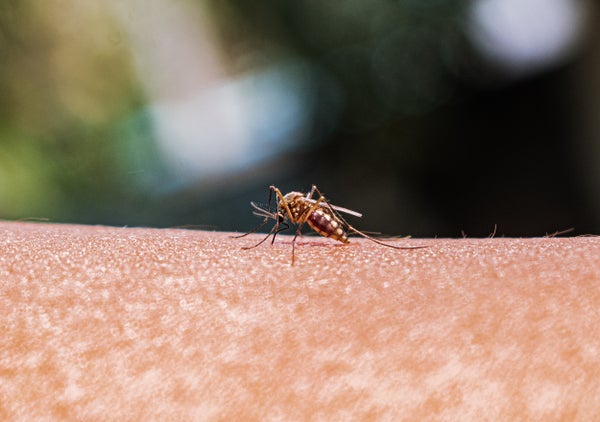
Health officials are investigating a case of possibly locally acquired malaria in New Jersey, just weeks after a health department in Washington State launched a similar investigation. The cases are sparking alarm over rising risks of mosquito-borne illnesses as climates warm.
According to the New Jersey Department of Health and the state’s Department of Environmental Protection, a resident of Morris County with no recent history of travel possibly came down with the mosquito-borne disease, which is marked by fever, headaches, chills and gastrointestinal symptoms. While the state sees about 100 cases of malaria that are contracted abroad each year, if confirmed, the Morris County case will be New Jersey’s first case of locally acquired malaria since 1991.
Washington State has reported a similar case. A patient in Pierce County with no recent travel history was diagnosed with possible malaria on August 2, prompting the Tacoma-Pierce County Health Department to begin trapping and testing mosquitoes for the disease-causing Plasmodium parasite, which the insects transmit with their bites. If it is determined to be locally acquired, the case will be the first non-travel-related malaria infection known in Washington State.
On supporting science journalism
If you're enjoying this article, consider supporting our award-winning journalism by subscribing. By purchasing a subscription you are helping to ensure the future of impactful stories about the discoveries and ideas shaping our world today.
Malaria was once common in North America but was eliminated from the U.S. by 1951 by a national campaign that pushed for pesticide use and drainage of mosquito breeding sites. Most of the country still hosts species of Anopheles mosquitoes that can transmit the Plasmodium parasite, however. According to the Centers for Disease Control and Prevention, there have been around 150 cases of malaria caught within the U.S. in the past 50 years.
The reason that these infections haven’t triggered a wider epidemic is malaria’s tricky transmission. The malaria-causing parasite can only be transmitted from a human host to a mosquito in a certain phase of its life cycle. The infected insect, carrying Plasmodium, then has to bite another person 10 to 15 days later, when the parasite has sufficiently developed, in order to transmit it back into a human. Mosquito lifespans in the wild aren’t well known, says Photini Sinnis, who studies malaria transmission at the Malara Research Institute at the Johns Hopkins Bloomberg School of Public Health. But in the lab, the insects start to die of old age at around 20 days, meaning many may not live to make that malaria-transmitting bite.
The Anopheles mosquitoes found in sub-Saharan Africa, where malaria is endemic, almost exclusively bite humans, so their chances of spreading the parasite are pretty high. Fortunately, the Anopheles species in the U.S. feed on multiple species, only biting humans if one happens to be nearby when they’re looking for a blood meal. That means they’re even less likely to bite two people, much less anyone in the tiny percentage of the population with infectious malaria.
But U.S.-acquired cases may be increasing—along with other mosquito-borne illness—as winters warm and summers lengthen, Sinnis says. Warmer weather means more mosquitoes, which means more opportunities for unlucky, disease-transmitting bites. While this likely still won’t be enough to re-establish malaria as a common threat, one-off locally acquired cases could become more regular.
“It’s all probabilities,” Sinnis says, “and warmer winters just will increase those probabilities.”