Secret Lives of Animals

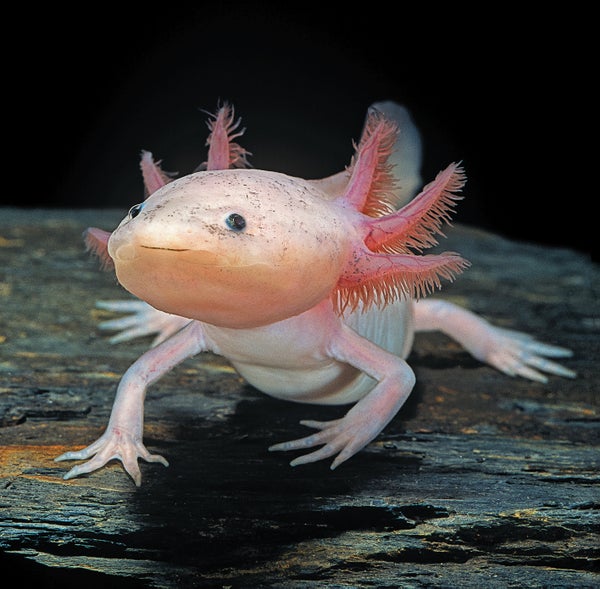
Mexican salamanders never undergo metamorphosis from larval stage to adult, which saves energy, helping them to survive in harsh climates.

Paul Starosta Getty Images

Join Our Community of Science Lovers!

In Africa, a species of termite builds columns of mud and spit, sometimes up to 18 feet tall. Paper wasps with brains the size of two grains of sand can recognize the faces of their fellow wasps. On the seafloor, dozens of unique marine bacteria, worms and crustaceans make their homes within rotting bones of dead whales.

Why do animals do such strange things? In this issue, scientists offer answers to this question. They also reveal surprising discoveries about how animals think and feel. And they explain how some of the oddest creatures ever to roam the earth came by their weird traits.

The animal behaviors that seem peculiar to us humans actually make a lot of sense for survival. Take, for instance, those termites. It turns out that their mud house is climate-controlled—the CO2 from the bugs' respiration rises out of the top of the mound, whereas at night the outer chambers of the column let in oxygen to keep the critters from suffocating. Other insects have crueler survival tactics. The female jewel wasp injects venom directly into a cockroach's brain to paralyze it, preserve it and feed it to her unborn spawn.


On supporting science journalism

If you're enjoying this article, consider supporting our award-winning journalism by subscribing. By purchasing a subscription you are helping to ensure the future of impactful stories about the discoveries and ideas shaping our world today.


Humans tend to think that we are unique in our intelligence, social skill and depth of emotion. Yet we think too much of ourselves. The humble chicken, for example, is strikingly clever. Males secretly subvert the pecking order—going behind the back of their more dominant rivals to court females. In the horse world, mares seem to provide the social glue to the herd—a job once attributed to stallions. Some wild animals even show what could be construed as grief: dolphins will carry the body of their dead calves with them, and elephants will revisit the bones of lost herd members for years after they die.

And then there are animals that are simply jaw dropping. The prehistoric bird Pelagornis sandersi, with its 24-foot wingspan—more than twice the wingspan of the albatross—was an unparalleled ocean soarer. And deep in the tunnels of wetlands, a tiny mole with a fleshy, pink nose the shape of a star devours up to five items of prey a second.

Enjoy this tour of the secret lives of animals. My guess is that you will feel somewhat at home, even among the strangest creatures. After all, we are animals, too.

Andrea Gawrylewski is chief newsletter editor at Scientific American. She writes the daily Today in Science newsletter and oversees all other newsletters at the magazine. In addition, she manages all special editions and in the past was the editor for Scientific American Mind, Scientific American Space & Physics and Scientific American Health & Medicine. Gawrylewski got her start in journalism at the Scientist magazine, where she was a features writer and editor for "hot" research papers in the life sciences. She spent more than six years in educational publishing, editing books for higher education in biology, environmental science and nutrition. She holds a master's degree in earth science and a master's degree in journalism, both from Columbia University, home of the Pulitzer Prize.

More by Andrea Gawrylewski
SA Special Editions Vol 26 Issue 2sThis article was published with the title “Amazing Animals” in SA Special Editions Vol. 26 No. 2s (), p. 1
doi:10.1038/scientificamericansecretlivesofanimals0517-1

It’s Time to Stand Up for Science

If you enjoyed this article, I’d like to ask for your support. Scientific American has served as an advocate for science and industry for 180 years, and right now may be the most critical moment in that two-century history.

I’ve been a Scientific American subscriber since I was 12 years old, and it helped shape the way I look at the world. SciAm always educates and delights me, and inspires a sense of awe for our vast, beautiful universe. I hope it does that for you, too.

If you subscribe to Scientific American, you help ensure that our coverage is centered on meaningful research and discovery; that we have the resources to report on the decisions that threaten labs across the U.S.; and that we support both budding and working scientists at a time when the value of science itself too often goes unrecognized.

In return, you get essential news, captivating podcasts, brilliant infographics, can't-miss newsletters, must-watch videos, challenging games, and the science world's best writing and reporting. You can even gift someone a subscription.

There has never been a more important time for us to stand up and show why science matters. I hope you’ll support us in that mission.

Thank you,

David M. Ewalt, Editor in Chief, Scientific American

Subscribe