
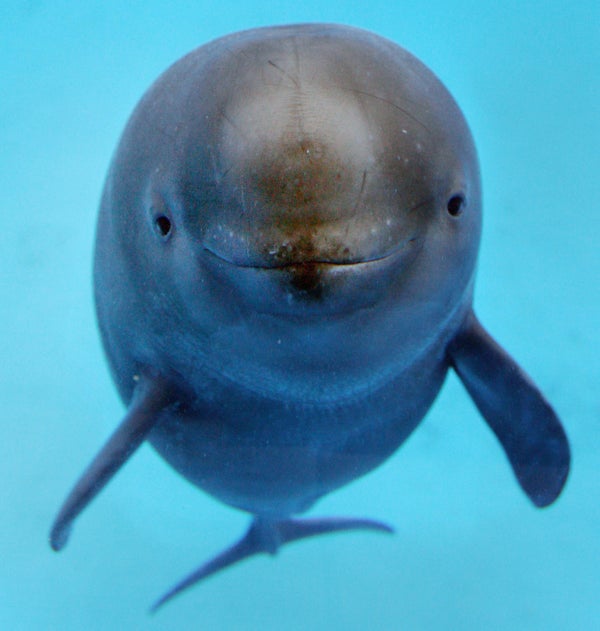
The best military sonar technology pales in comparison with the echolocation porpoises use to track prey, predators and obstacles. The marine mammals can find objects a few centimeters wide from 100 meters away—akin to spotting a walnut from across a football field—by releasing clicks from their blowholes. Sonar-equipped ships, in contrast, must emit sound waves from multiple sources spread out over at least a few meters. A recent study suggests porpoises' ultraefficient echolocation is made possible by adjustable structures in their heads—a finding that may help humans improve our own sonar technology.
Sonar works by bouncing sound waves off objects and detecting the signals' return time. Normally if the source of a sonar pulse is smaller than the wavelength of the sound, it releases sound signals in all directions, like light scattering from a disco ball. To send a targeted beam in a specific direction, the source must be much larger than the wavelength. But porpoises manage to evade this requirement.
To find out how, scientists used CT scans to study the heads of finless porpoises (Neophocaena phocaenoides). They learned the creatures' foreheads contain complicated structures involving air sacs, soft tissues and skull bones. These components make up layers that let sound pass through at different velocities, enabling the animals to control their beams' focus. “If we can understand these structures, then we can redesign our sonar systems and put them into [smaller] boats,” says Wenwu Cao, a physicist at Pennsylvania State University and co-author of the study, published last December in Physical Review Applied.
On supporting science journalism
If you're enjoying this article, consider supporting our award-winning journalism by subscribing. By purchasing a subscription you are helping to ensure the future of impactful stories about the discoveries and ideas shaping our world today.
The work suggests that porpoises share some tricks with another mammal famous for echolocation: bats. “I am intrigued that there could be a way for the porpoises to change their emission pattern by compressing the forehead complex,” says Rolf Müller, a professor of mechanical engineering at Virginia Tech, who has studied bat sonar but was not involved in the porpoise study. Next to human technology, it seems bats and porpoises really are a few flaps or laps ahead.