
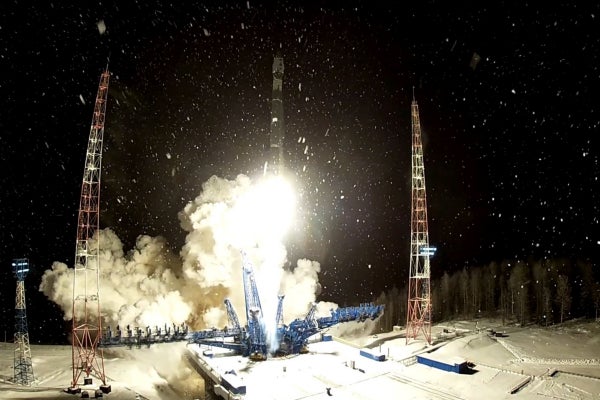
A trio of secretive Russian satellites launched earlier this year has released a mysterious object into orbit, sparking interest among space trackers and analysts.
The three satellites, designated Kosmos 2581, 2582 and 2583, launched on a Soyuz-2.1V rocket from Plesetsk cosmodrome early on Feb. 2 (GMT). Since then, the satellites, whose purpose is unknown, have displayed interesting behavior, while in a near-polar orbit roughly 364 miles (585 kilometers) above Earth.
In March, the satellites appeared to be conducting potential proximity operations, or maneuvering close to other objects in space, according to Jonathan McDowell, an astrophysicist and spaceflight activity tracker.
On supporting science journalism
If you're enjoying this article, consider supporting our award-winning journalism by subscribing. By purchasing a subscription you are helping to ensure the future of impactful stories about the discoveries and ideas shaping our world today.
Following this, the U.S. Space Force cataloged a new object in orbit, which was possibly released by Kosmos 2581 on March 18.
Russia has provided no details about the satellites and their mission. Many Kosmos missions are classified.
The released object could be used for a number of objectives, including military experiments, such as satellite inspection or target practice, testing technology for docking or formation flying. It may also be a scientific payload or even the result of an unintentional fragmentation, though this would usually result in numerous pieces of debris.
The Kosmos (or Cosmos) designation has been used by the Soviet Union and later Russia for a very wide range of military and scientific satellites since 1962. The satellites have covered a range of apparent uses, some of which are experimental, secret, or part of military programs, including early ASAT (anti-satellite) tests and satellite inspection, reconnaissance and electronic intelligence.
Satellite trios flying in formation in orbit is not unusual. Both the United States (for example, the Naval Ocean Surveillance System) and China (Yaogan) have launched numerous sets of satellite triplets, many of which are thought to be for electronic intelligence purposes, along with other satellite series.
However, it remains to be seen what the three Kosmos satellites and their new companion will get up to in orbit.
Copyright 2025 Space.com, a Future company. All rights reserved. This material may not be published, broadcast, rewritten or redistributed.