See Fast Radio Bursts Come of Age

An incipient field of radio astronomy is about to go mainstream

Katie Peek

Join Our Community of Science Lovers!

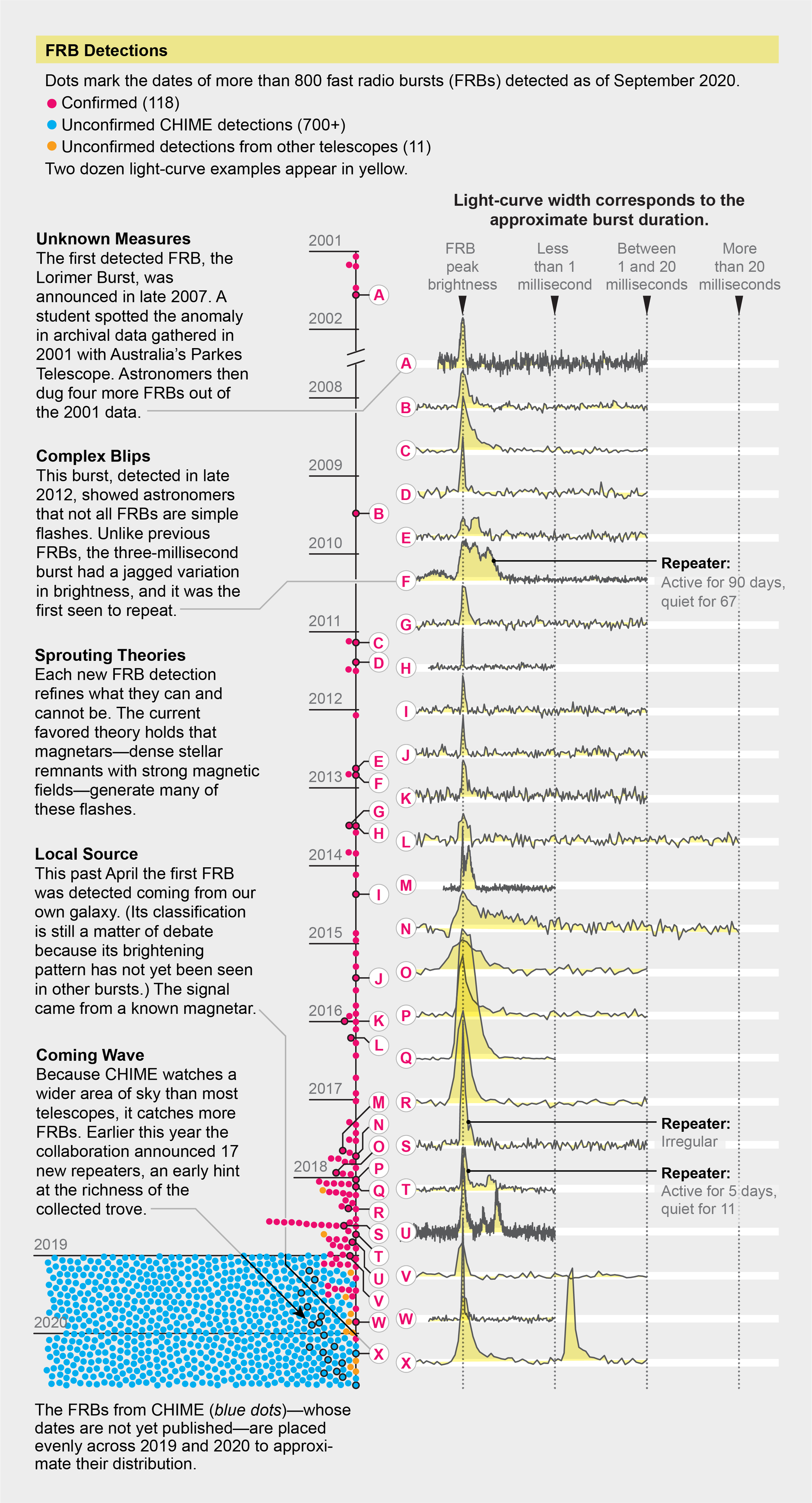
New subfields in astronomy tend to follow a particular sequence: Something new is observed. Researchers scratch their heads, then look for more examples of it. At first, each discovery in the new category—say, an exoplanet or gravitational-wave event—generates excitement. Eventually they begin to feel routine. But that is when the science gets interesting: with enough examples, patterns emerge, and inaccurate hypotheses are weeded out.

In 2020 the study of fast radio bursts (FRBs) has crested to that point. For nearly two decades radio telescopes have been detecting these distinctive pinpoints of radio light. They come from distant galaxies and last just a fraction of a second, typically never to reappear. With hundreds of FRBs now recorded, researchers have enough data points to begin drawing conclusions about the universe.

One big player in the search is the Canadian Hydrogen Intensity Mapping Experiment (CHIME), a telescope that has detected more than 700 FRBs since the start of 2019. CHIME researcher Cherry Ng says that with all the new results coming in and with coordination among astronomers growing, “we can all work together to figure out what these are.” Here's the story of this field so far.


On supporting science journalism

If you're enjoying this article, consider supporting our award-winning journalism by subscribing. By purchasing a subscription you are helping to ensure the future of impactful stories about the discoveries and ideas shaping our world today.

Credit: Katie Peek; Sources: FRB Catalogue; Canadian Hydrogen Intensity Mapping Experiment (chime)

Katie Peek is a science journalist and data-visualization designer with degrees in astrophysics and journalism. She is a contributing artist for Scientific American.

More by Katie Peek
Scientific American Magazine Vol 323 Issue 6This article was published with the title “Fast Radio Bursts Grow Up” in Scientific American Magazine Vol. 323 No. 6 (), p. 20
doi:10.1038/scientificamerican1220-20

It’s Time to Stand Up for Science

If you enjoyed this article, I’d like to ask for your support. Scientific American has served as an advocate for science and industry for 180 years, and right now may be the most critical moment in that two-century history.

I’ve been a Scientific American subscriber since I was 12 years old, and it helped shape the way I look at the world. SciAm always educates and delights me, and inspires a sense of awe for our vast, beautiful universe. I hope it does that for you, too.

If you subscribe to Scientific American, you help ensure that our coverage is centered on meaningful research and discovery; that we have the resources to report on the decisions that threaten labs across the U.S.; and that we support both budding and working scientists at a time when the value of science itself too often goes unrecognized.

In return, you get essential news, captivating podcasts, brilliant infographics, can't-miss newsletters, must-watch videos, challenging games, and the science world's best writing and reporting. You can even gift someone a subscription.

There has never been a more important time for us to stand up and show why science matters. I hope you’ll support us in that mission.

Thank you,

David M. Ewalt, Editor in Chief, Scientific American

Subscribe