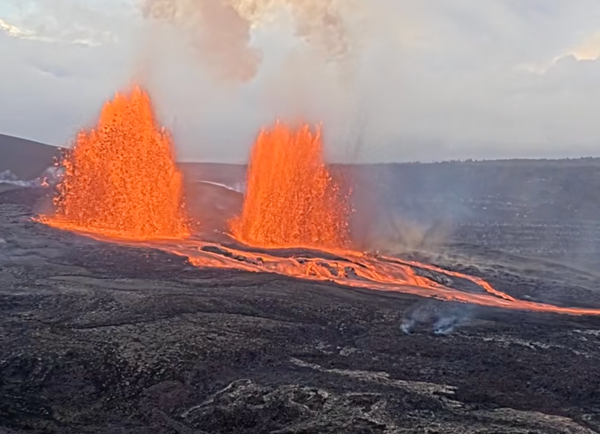
Hawaii’s Kīlauea volcano erupts, shooting lava 1,300 feet into the air

Over nine hours, Kīlauea released 16 million cubic yards of lava and sent a cloud of ash beyond 30,000 feet

Kīlauea volcano in Hawaii is seen mideruption, with two large plumes of lava jetting into the sky

USGS

Join Our Community of Science Lovers!

The Kīlauea volcano on Hawaii’s Big Island erupted on Tuesday in a nine-hour spectacular in which it shot fountains of lava some 1,300 feet into the air, according to the U.S. Geological Survey.

The eruption generated “significant heat and ash,” USGS said, with some six inches of “tephra”—bits of volcanic material, ranging from glasslike particles to rocks and ash—accumulating on a nearby golf course.

Some glassy material, called “Pele’s hair” for its strandlike structure, traveled as far as Hilo, USGS said. Hilo is some 30 miles away by car. Over the course of the eruption on Tuesday, Kīlauea released an estimated 16 million cubic yards of lava and sent up an ash plume that reached beyond 30,000 feet.


On supporting science journalism

If you're enjoying this article, consider supporting our award-winning journalism by subscribing. By purchasing a subscription you are helping to ensure the future of impactful stories about the discoveries and ideas shaping our world today.


Kīlauea has been erupting regularly since December 2024; Tuesday’s fiery display was the 43rd “eruptive episode” since then.

Live thermal image of Halemaʻumaʻu from the west rim of the summit caldera

A GIF of a thermal image of Halemaʻumaʻu from the west rim of the summit caldera.

USGS

Kīlauea is a shield volcano, which means it is flatter and shorter than the classic conical peak of a composite volcano. But what such volcanoes lack in height, they make up for in size—much wider than they are high, shield volcanoes are the largest volcanoes on Earth. These volcanoes often produce slow-moving lava flows. Kīlauea is among the planet’s most active volcanoes and has been erupting for as long as humans have been around to document it.

Jackie Flynn Mogensen is a breaking news reporter at Scientific American. Before joining SciAm, she was a science reporter at Mother Jones, where she received a National Academies Eric and Wendy Schmidt Award for Excellence in Science Communications in 2024. Mogensen holds a master’s degree in environmental communication and a bachelor’s degree in earth sciences from Stanford University. She is based in New York City.

More by Jackie Flynn Mogensen

It’s Time to Stand Up for Science

If you enjoyed this article, I’d like to ask for your support. Scientific American has served as an advocate for science and industry for 180 years, and right now may be the most critical moment in that two-century history.

I’ve been a Scientific American subscriber since I was 12 years old, and it helped shape the way I look at the world. SciAm always educates and delights me, and inspires a sense of awe for our vast, beautiful universe. I hope it does that for you, too.

If you subscribe to Scientific American, you help ensure that our coverage is centered on meaningful research and discovery; that we have the resources to report on the decisions that threaten labs across the U.S.; and that we support both budding and working scientists at a time when the value of science itself too often goes unrecognized.

In return, you get essential news, captivating podcasts, brilliant infographics, can't-miss newsletters, must-watch videos, challenging games, and the science world's best writing and reporting. You can even gift someone a subscription.

There has never been a more important time for us to stand up and show why science matters. I hope you’ll support us in that mission.

Thank you,

David M. Ewalt, Editor in Chief, Scientific American

Subscribe