See How Humans around the World Spend the 24 Hours in a Day

A new study calculated the average “global human day,” revealing which activities take up most of our time

Join Our Community of Science Lovers!


On supporting science journalism

If you're enjoying this article, consider supporting our award-winning journalism by subscribing. By purchasing a subscription you are helping to ensure the future of impactful stories about the discoveries and ideas shaping our world today.


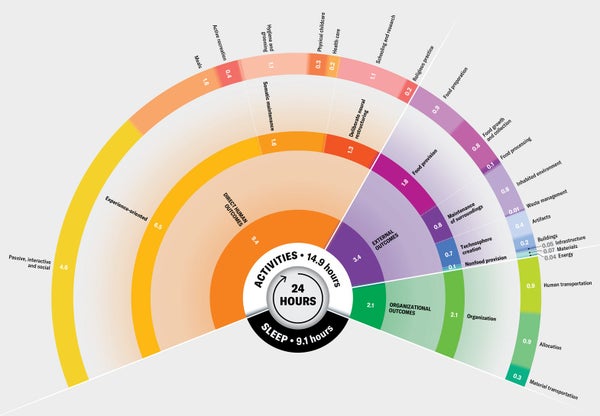
Every human on Earth has the same 24 hours to spend in a day—but the way we divide those hours for work and sleep and school and play varies a lot. In 2023 scientists compiled the available data about how people around the world allocate their time and used them to define the average "global human day." More than a third of our hours are spent in bed, they found, with the rest split among three categories the researchers devised based on whether the time directly affected humans, the physical world, or where and what people are doing. Activities such as agriculture took up much more time in poorer countries than in wealthier ones, whereas others such as human transportation were fairly constant everywhere. Ultimately the study found that relatively little time—about five minutes per average human day—goes to activities that directly alter the environment and climate change, such as extracting energy and dealing with waste, suggesting an opportunity to put in more time to help the planet. "We have to switch off fossil-fuel energy and construct more renewables," says study co-author Eric Galbraith of McGill University. "If it turned out that the changes we want to make required huge allocations of time to activities we're not doing now, then it would be impossible. But we can tackle this with just a couple of minutes per day. I think that's hopeful."
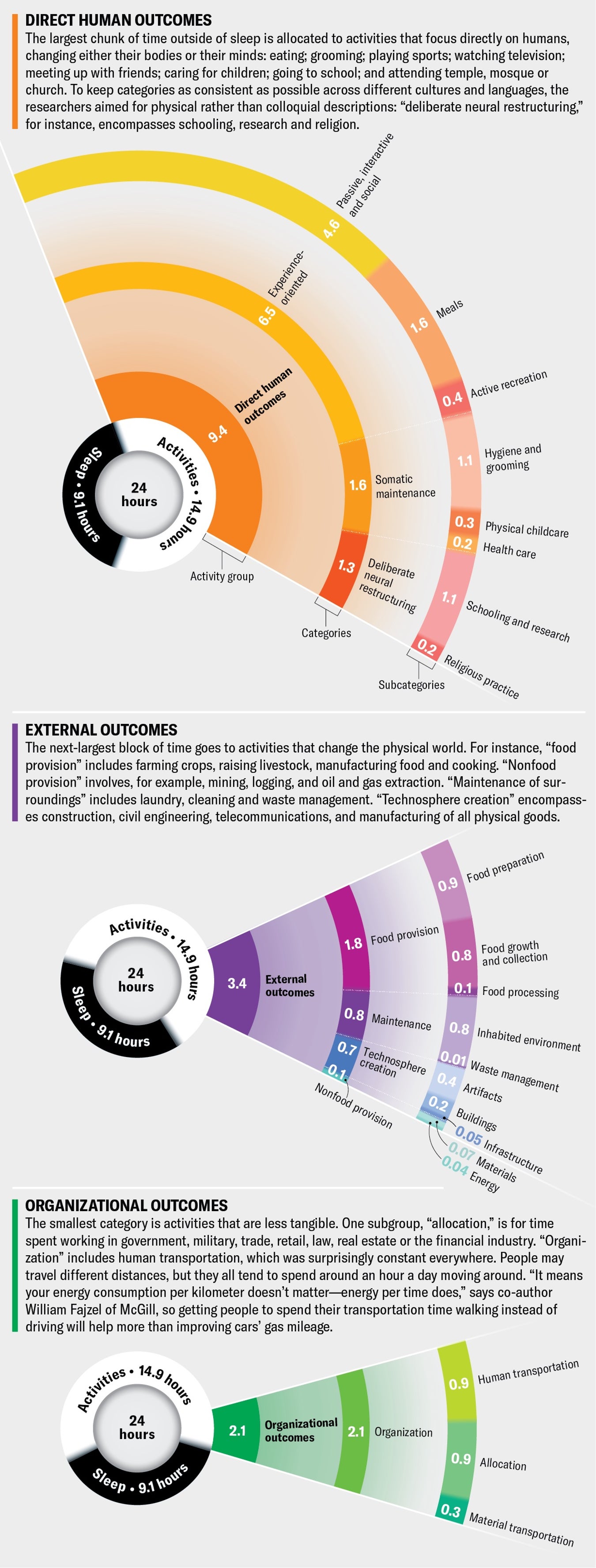
Credit: Studio Terp; Source: “The Global Human Day,” by William Fajzel et al., in PNAS, Vol. 120; June 2023 (data)

Clara Moskowitz is chief of reporters at Scientific American, where she covers astronomy, space, physics and mathematics. She has been at Scientific American for more than a decade; previously she worked at Space.com. Moskowitz has reported live from rocket launches, space shuttle liftoffs and landings, suborbital spaceflight training, mountaintop observatories, and more. She has a bachelor’s degree in astronomy and physics from Wesleyan University and a graduate degree in science communication from the University of California, Santa Cruz.

More by Clara Moskowitz

Studio Terp is Sonja Kuijpers's one-woman data illustration studio based in Eindhoven, the Netherlands. She sets out to make sense of numbers, experimenting with shapes and styles to create appealing humanistic data illustrations.

More by Studio Terp
Scientific American Magazine Vol 329 Issue 4This article was published with the title “How We Spend Our Time” in Scientific American Magazine Vol. 329 No. 4 (), p. 94
doi:10.1038/scientificamerican1123-94

It’s Time to Stand Up for Science

If you enjoyed this article, I’d like to ask for your support. Scientific American has served as an advocate for science and industry for 180 years, and right now may be the most critical moment in that two-century history.

I’ve been a Scientific American subscriber since I was 12 years old, and it helped shape the way I look at the world. SciAm always educates and delights me, and inspires a sense of awe for our vast, beautiful universe. I hope it does that for you, too.

If you subscribe to Scientific American, you help ensure that our coverage is centered on meaningful research and discovery; that we have the resources to report on the decisions that threaten labs across the U.S.; and that we support both budding and working scientists at a time when the value of science itself too often goes unrecognized.

In return, you get essential news, captivating podcasts, brilliant infographics, can't-miss newsletters, must-watch videos, challenging games, and the science world's best writing and reporting. You can even gift someone a subscription.

There has never been a more important time for us to stand up and show why science matters. I hope you’ll support us in that mission.

Thank you,

David M. Ewalt, Editor in Chief, Scientific American

Subscribe