See How Stress Affects Inflammatory Bowel Disease

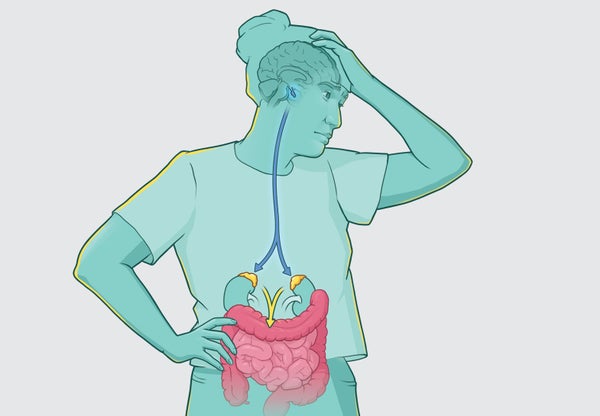
In inflammatory bowel disease, mental stress can produce two painful responses

Graphic shows a human figure with an arrow leading from the pituitary gland in the brain to adrenal glands on the kidneys. Additional arrows lead from the adrenal glands to the intestines.

Now Medical Studios

Join Our Community of Science Lovers!


On supporting science journalism

If you're enjoying this article, consider supporting our award-winning journalism by subscribing. By purchasing a subscription you are helping to ensure the future of impactful stories about the discoveries and ideas shaping our world today.


Bouts of disabling pain, bleeding, weight loss and hospitalization that sometimes require surgery: that's the lot of about three million adults in the U.S. who suffer from inflammatory bowel disease, or IBD. (The illness has two main forms, Crohn's disease and ulcerative colitis. It is frequently associated with an overactive immune system and may have a genetic component.) Treatments often involve some variety of immunosuppressant such as a steroid drug. But even controlled cases have periodic flare-ups, and the reasons have been hard to pin down.

Now scientists have traced two detailed molecular pathways from the brain to the gut that produce IBD flares. And in three different groups of IBD patients, they found that psychological stress—a death in the family or a bad fight with a loved one, for instance—can trigger the release of brain chemicals that cause IBD symptoms. This doesn't mean IBD is all in the head, emphasizes Christoph A. Thaiss of the University of Pennsylvania, one of the researchers. But it does mean psychotherapy and targeted stress-management techniques have important—and until now underappreciated—roles to play in preventing and treating agonizing flares.

Now Medical Studios; Source: “The Enteric Nervous System Relays Psychological Stress to Intestinal Inflammation,” by Kai Markus Schneider et al., in Cell, Vol. 186; June 22, 2023 (reference)

Josh Fischman is senior editor for special projects at Scientific American and covers medicine, biology and science policy. He has written and edited about science and health for Discover, ScienceEarth and U.S. News & World Report. Follow Fischman on Bluesky @jfischman.bsky.social

More by Josh Fischman

Now Medical Studios is a multidisciplinary studio that creates medical illustrations and animations for clients in the pharmaceutical and healthcare industries.

More by Now Medical Studios
Scientific American Magazine Vol 329 Issue 2This article was published with the title “The Brain-Gut Connection” in Scientific American Magazine Vol. 329 No. 2 (), p. 86
doi:10.1038/scientificamerican0923-86

It’s Time to Stand Up for Science

If you enjoyed this article, I’d like to ask for your support. Scientific American has served as an advocate for science and industry for 180 years, and right now may be the most critical moment in that two-century history.

I’ve been a Scientific American subscriber since I was 12 years old, and it helped shape the way I look at the world. SciAm always educates and delights me, and inspires a sense of awe for our vast, beautiful universe. I hope it does that for you, too.

If you subscribe to Scientific American, you help ensure that our coverage is centered on meaningful research and discovery; that we have the resources to report on the decisions that threaten labs across the U.S.; and that we support both budding and working scientists at a time when the value of science itself too often goes unrecognized.

In return, you get essential news, captivating podcasts, brilliant infographics, can't-miss newsletters, must-watch videos, challenging games, and the science world's best writing and reporting. You can even gift someone a subscription.

There has never been a more important time for us to stand up and show why science matters. I hope you’ll support us in that mission.

Thank you,

David M. Ewalt, Editor in Chief, Scientific American

Subscribe