See Ingenuity Team’s Joy after the First Mars Helicopter Soars

Scientists and engineers react with elation to the historic interplanetary flight

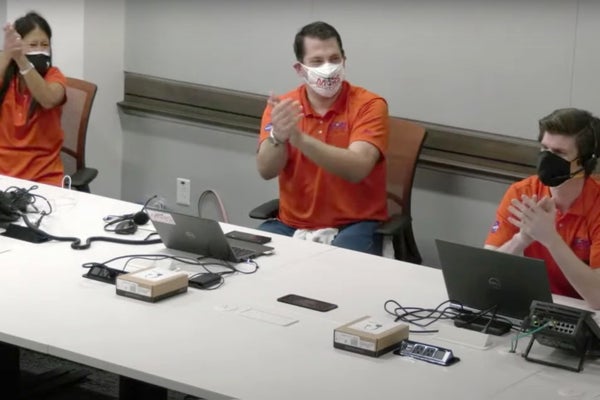
Ingenuity team reacts after the first Mars helicopter soars.

Team members react to news of the successful flight of the Mars helicopter Ingenuity, the first aircraft to fly on another planet.

Join Our Community of Science Lovers!

Just after 3:30 A.M. EST this morning—and a half-hour past noon on Mars—NASA’s Ingenuity helicopter became the first aircraft to fly on another world. Hovering at an altitude of three meters for some 30 seconds, the solar-powered aircraft’s first flight was more of a modest hop than a giant leap. But it opened the way for up to four more aerial forays in coming weeks—and a new era of airborne interplanetary exploration.

Captured by Ingenuity—as well as its “mothership,” the Perseverance rover—the first flight’s stunning images will undoubtedly make their way into history books. But the event’s most poignant pictures emerged right here on Earth, taken in an austere room at NASA’s Jet Propulsion Laboratory in Pasadena, Calif. There, the team behind Ingenuity had waited for more than three nail-biting hours for news of the helicopter’s success, which was delayed by the need for Perseverance to relay the flight’s data to a satellite orbiting overhead and then to Earth. Success was far from guaranteed: flying on Mars is no easy feat because the planet’s atmosphere is just one hundredth as dense as Earth’s, requiring Ingenuity’s blades to spin at more than 2,500 revolutions per minute.

Finally, at 6:46 A.M. EST, the confirmation came. “Altimeter data confirms that Ingenuity has performed its first flight—the first powered flight of a powered aircraft on another planet,” announced Håvard Grip, Ingenuity’s chief pilot, as he monitored the incoming telemetry.


On supporting science journalism

If you're enjoying this article, consider supporting our award-winning journalism by subscribing. By purchasing a subscription you are helping to ensure the future of impactful stories about the discoveries and ideas shaping our world today.


After years of hard work on the high-risk project, for a few brief moments the team members allowed their elation to take over.

Less than five minutes later, while watching Perseverance’s video of the hovering craft, Ingenuity’s project manager MiMi Aung declared the test a “success” and ceremoniously ripped up printouts of contingency procedures. “We can now say that human beings have flown a rotorcraft on another planet!” Aung said. For now she encouraged her team to enjoy the celebration. But “after that, let’s get back to work—and more flights!” she said.

Lee Billings is a science journalist specializing in astronomy, physics, planetary science, and spaceflight and is senior desk editor for physical science at Scientific American. He is author of a critically acclaimed book, Five Billion Years of Solitude: The Search for Life Among the Stars, which in 2014 won a Science Communication Award from the American Institute of Physics. In addition to his work for Scientific American, Billings’s writing has appeared in the New York Times, the Wall Street Journal, the Boston Globe, Wired, New Scientist, Popular Science and many other publications. Billings joined Scientific American in 2014 and previously worked as a staff editor at SEED magazine. He holds a B.A. in journalism from the University of Minnesota.

More by Lee Billings

It’s Time to Stand Up for Science

If you enjoyed this article, I’d like to ask for your support. Scientific American has served as an advocate for science and industry for 180 years, and right now may be the most critical moment in that two-century history.

I’ve been a Scientific American subscriber since I was 12 years old, and it helped shape the way I look at the world. SciAm always educates and delights me, and inspires a sense of awe for our vast, beautiful universe. I hope it does that for you, too.

If you subscribe to Scientific American, you help ensure that our coverage is centered on meaningful research and discovery; that we have the resources to report on the decisions that threaten labs across the U.S.; and that we support both budding and working scientists at a time when the value of science itself too often goes unrecognized.

In return, you get essential news, captivating podcasts, brilliant infographics, can't-miss newsletters, must-watch videos, challenging games, and the science world's best writing and reporting. You can even gift someone a subscription.

There has never been a more important time for us to stand up and show why science matters. I hope you’ll support us in that mission.

Thank you,

David M. Ewalt, Editor in Chief, Scientific American

Subscribe