
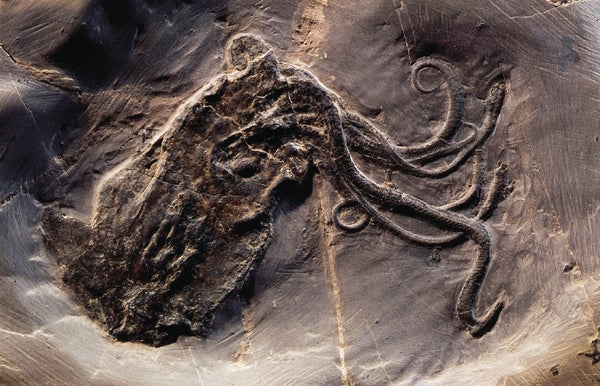
A good cephalopod fossil is hard to find. Although ammonite shells, belemnite guards and other indicators of hard body parts are abundant in the fossil record, paleontologists seldom get to see the characteristic soft-tissue anatomy of these many-armed swimmers. Finds are so rare that one from 1982 still stands out: a 165-million-year-old fossilized octopus uncovered in France.
J. C. Fischer and B. Riou named the eight-armed invertebrate Proteroctopus ribeti and described its suckers to the delight of other paleontologists. But despite its unprecedented level of detail, the fossil looked deflated—an animal preserved as a squished version of its former self. That made it difficult to figure out the particulars of the specimen's anatomy and how it related to other octopuses. More than three decades later paleontologist Isabelle Kruta of Pierre and Marie Curie University in Paris and her colleagues have provided more detail about what this emblematic cephalopod looked like when alive. They reconstructed the animal in 3-D using synchrotron microtomography, a high-definition imaging technique.
Reinflated and restored, Proteroctopus most likely falls within a major octopus group called Vampyropoda—which contains the common octopus as well as the vampire “squid.” With the new images, the researchers found that Proteroctopus looked something like today's deep-sea forms of Vampyropoda—with a few differences. For instance, the ancient specimen has eight arms and a fin sticking out on either side of its body. Proteroctopus also lacks an ink sac, like the modern Vampyroteuthis. But the suckers of this Jurassic invertebrate are obliquely offset from one another rather than occurring side by side as in many extant octopuses. The study was published last fall in Palaeontology.
On supporting science journalism
If you're enjoying this article, consider supporting our award-winning journalism by subscribing. By purchasing a subscription you are helping to ensure the future of impactful stories about the discoveries and ideas shaping our world today.
What Proteroctopus can tell us about the ancestral octopus will rely on finding more fossils, but the specimen adds to an emerging consensus that octopus body shapes were already widely diversified by about 164 million years ago. “[Characteristics] we thought were quite recent in the evolution of the group, such as the shape of some suckers, were already present in the Jurassic,” Kruta says. As for what else the fossil record holds, paleontologists would surely give an arm and a leg to know.