
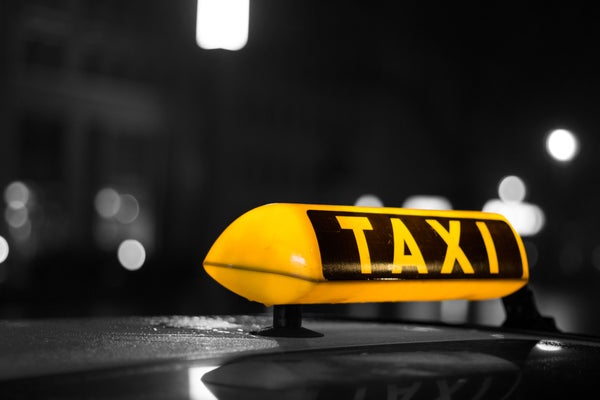
The world could get a glimpse of a futuristic transportation system in which people get around in self-driving electric taxis as soon as next year.
General Motors Co. and Lyft Inc. will start testing self-driving taxis with real customers within a year in a pilot program that could include electric vehicles, a Lyft executive told The Wall Street Journal.
Those looking to cut carbon emissions from transportation have called the combination a “best case scenario” that could reduce pollution per mile by as much as 94 percent by 2030, according to a Nature Climate Change paper last year (ClimateWire, July 7, 2015).
On supporting science journalism
If you're enjoying this article, consider supporting our award-winning journalism by subscribing. By purchasing a subscription you are helping to ensure the future of impactful stories about the discoveries and ideas shaping our world today.
“It’s much faster than I had expected,” said Jeffery Greenblatt, an energy researcher at the Lawrence Berkeley National Laboratory and an author of that paper, about the testing timeline proposed by Lyft. “I had said 2030, and here we are already with companies jumping in to be first ones.
“It shows that there is a strong business case,” he added. “I hope that pans out in testing and that they are as useful and low carbon as we estimated that they are.”
The pilot would represent a milestone in the partnership between General Motors and Lyft, which began in January with a $500 million investment by the automaker.
In March, the two companies launched a program in Chicago to let Lyft drivers lease General Motors cars, starting with Chevrolet Equinox crossovers. The program is set to expand soon to other cities and models. General Motors will release the Chevrolet Bolt, an electric car with a 200-mile range, later this year and aims to make Lyft drivers major customers.
Meanwhile, the automaker’s development of driverless technology sped up last month with an announcement it would try to purchase a San Francisco startup for $1 billion. Cruise Automation Inc. specializes in adding autonomous driving software to existing vehicles.
The driverless electric taxi pilot would occur in a yet-to-be-disclosed city. Lyft already has a prototype smartphone application that would let customers choose whether they wanted to be picked up by an autonomous car, according to The Wall Street Journal.
A General Motors spokesperson would not divulge additional details but wrote in an email that “GM continues to make progress on our previously announced plans related to an integrated on-demand autonomous network with Lyft. Similarly, we have said the Chevrolet Bolt EV is the ideal platform for ride sharing solutions. We believe electrification blends perfectly with autonomy when it comes to technology integration.”
Lyft did not respond to a request for comment.
Clean? Depends on where the plug is
The project comes amid a race to develop driverless cars that pits legacy automakers in Detroit against technology upstarts in Silicon Valley.
Uber Technologies Inc., larger than Lyft, has its own self-driving research center in Pittsburgh. Alphabet Inc.’s Google has already tested self-driving cars on public roads in California. This week, it struck a deal for self-driving minivan prototypes with Fiat Chrysler Automobiles. Mercedes-Benz, Audi AG, Nissan Motor Co. Ltd. and others are all developing autonomous driving technology. Tesla Motors Inc.’s electric cars have autonomous driving features like self-parking. Small electric driverless buses have started testing on European roads.
Last week, Google, Ford Motor Co., Uber, Volvo Cars Corp. and Lyft formed a group to push for federal action to speed up driverless cars called the Self-Driving Coalition for Safer Streets. The Obama administration has asked Congress for funding for research into driverless cars, and appropriators have responded favorably.
Researchers remain unclear about the technology’s effect on carbon emissions from the transportation sector. More efficient driving and reduced congestion from fewer traffic accidents could cut fuel use (ClimateWire, Jan. 19), but the convenience could invite more and longer trips, erasing those savings (ClimateWire, Feb. 26). The Department of Energy expects driverless cars to do anything from reducing emissions 90 percent to increasing them 200 percent.
Real-world tests like the one by Lyft and General Motors could bring some clarity, said Costa Samaras, an assistant professor in the Department of Civil and Environmental Engineering at Carnegie Mellon University. General Motors funds research into driverless technology at the university.
“One of the big real opportunities from companies’ perspective is they can measure user experience. They can measure what they’re willing to pay or where people are frustrated with the technology,” Samaras said. “That’s exciting from an engineering and design perspective.”
The added use of electric vehicles would slash fuel use to zero, but the overall emissions depend on the region. A car that plugs into a clean grid in New York would pollute significantly less than one that plugs into a coal-powered grid in the Midwest.
“That’s one of the reasons the electricity system needs to get decarbonized, is to hedge against a future where you have lots and lots of vehicle miles traveled,” Samaras said.
Reprinted from Climatewire with permission from Environment & Energy Publishing, LLC. www.eenews.net, 202-628-6500