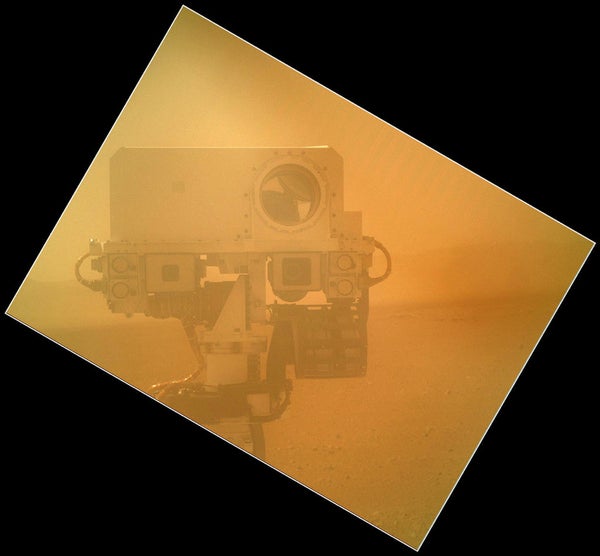
That's no Instagram filter lending a nostalgic sepia tint to the image above. The reddish haze pervading the photo of NASA's Curiosity rover comes from a protective dust cover shielding the lens of the rover's Mars Hand Lens Imager (MAHLI), which took the picture September 7.
NASA/JPL-Caltech/Malin Space Science Systems
Join Our Community of Science Lovers!
That's no Instagram filter lending a nostalgic sepia tint to the image above.
The reddish haze pervading the photo of NASA's Curiosity rover comes from a protective dust cover shielding the lens of the rover's Mars Hand Lens Imager (MAHLI), which took the picture September 7.
So named because it is meant to fill the role of the handheld magnifying glass for a human geologist, MAHLI is equipped with two light sources—one producing white light and the other radiating ultraviolet light—for illuminating geologic specimens. The imager is mounted on the end of Curiosity's robotic arm, which allowed it to turn and snap a portrait-style shot of the cameras and other instruments mounted in the "head" at the top of the rover's more than two-meter-high vertical mast.
On supporting science journalism
If you're enjoying this article, consider supporting our award-winning journalism by subscribing. By purchasing a subscription you are helping to ensure the future of impactful stories about the discoveries and ideas shaping our world today.
At the same time, the cameras atop the mast were inspecting MAHLI, its dust cover and other instruments on the 2.1-meter-long robotic arm. Having received a clean bill of health, MAHLI opened its cover the following day and began imaging the rover's environs with newfound clarity.
It’s Time to Stand Up for Science
If you enjoyed this article, I’d like to ask for your support. Scientific American has served as an advocate for science and industry for 180 years, and right now may be the most critical moment in that two-century history.
SciAm always educates and delights me, and inspires a sense of awe for our vast, beautiful universe. I hope it does that for you, too.
If you subscribe to Scientific American, you help ensure that our coverage is centered on meaningful research and discovery; that we have the resources to report on the decisions that threaten labs across the U.S.; and that we support both budding and working scientists at a time when the value of science itself too often goes unrecognized.