
1970
1970 Pacific Junction
“A four-week Pacific cruise this spring by the U.S. Navy research vessel DeSteiguer has produced further evidence that the earth's crust consists of discrete drifting plates. The voyage provides an example of theory successfully predicting fact: if three oceanic plates should drift apart, a wedge-shaped area would appear on the seafloor with its apex at the triple juncture. The McKenzie-Morgan hypothesis was published jointly in 1968; it led one of W. Jason Morgan's Princeton colleagues, Kenneth S. Deffeyes, to calculate the size and shape of the triple-juncture wedge to be expected in the Galápagos area. Deffeyes then led the DeSteiguer expedition and collected the data that proved the correctness of the hypothesis.”
On supporting science journalism
If you're enjoying this article, consider supporting our award-winning journalism by subscribing. By purchasing a subscription you are helping to ensure the future of impactful stories about the discoveries and ideas shaping our world today.
1920
Malaria Control
“Among the unusual control methods adopted in the prevention of the hatching of mosquito larvae is the spraying of streams with kerosene or a heavy black oil, classified by dealers as a grade immediately below fuel oil. The application is made with knapsack pump sprayers or by means of automatic drip cans. Of course, the expensiveness of the oil is a factor to reckon with, but one small Southern lumbering town made effective its control operations at a per capita cost of $1.23. Moreover, the visits of the physicians for the purpose of treating malaria were reduced 70 percent compared with the previous year.”
1870
Modern Timepieces
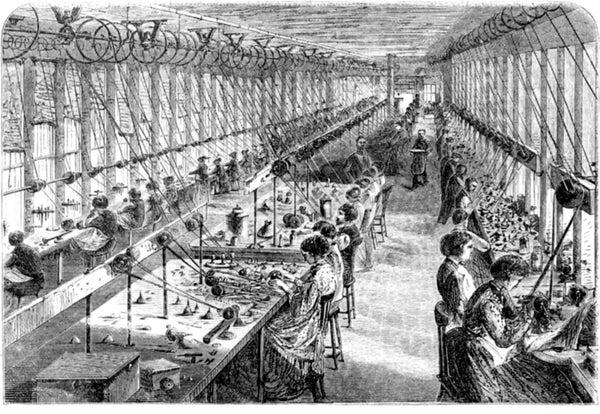
“In the Waltham Watch Factory, simple hand machines, with which a few of the parts of the watch had been produced, were here brought together, and hundreds of new ones, at many hundreds of thousands of dollars' cost, were created, and all interwoven, as it were, into one vast mechanical organism. A single steam engine distributes its power by means of driving shafts through a whole colony of similar working rooms, and the result is the production of watches at the rate of one every three minutes, and with a uniformity and perfection which have at once and forever antiquated all previous methods of their production.”
Inventive Talent
“In our practice as patent solicitors we have frequently been called upon to prepare applications for female inventors; and we can say to those who are unbelievers in regard to the power of women to achieve, as a class, anything higher than a pound-cake or a piece of embroidery, that the inventions made by women, and for which they solicit patents through our agency, are generally found to be in their practical character, and in their adaptation and selection of means to effect a definite purpose, fully equal to the inventions made by men.”
How We Make Things

1982: By the time this September issue was published, computers, which emerged in the 1940s, were common in most workplaces.
Humans, for a long time, have been planning for future needs by making things. The industrial revolution, starting in about 1760, replaced traditional energy sources with the power of steam. From the founding of this magazine in 1845 and for the next century, the efforts of physics and chemistry—with help from the new management sciences—created more and better machines and energy sources, increased the amount of goods made and the appetite for raw materials. Electronic computers appeared in the 1940s and by the 1980s were coming into widespread use for guiding machines. Perhaps someday we will harness the power of nature and use chemical bonds and biological materials to do our labor for us. —D.S.