
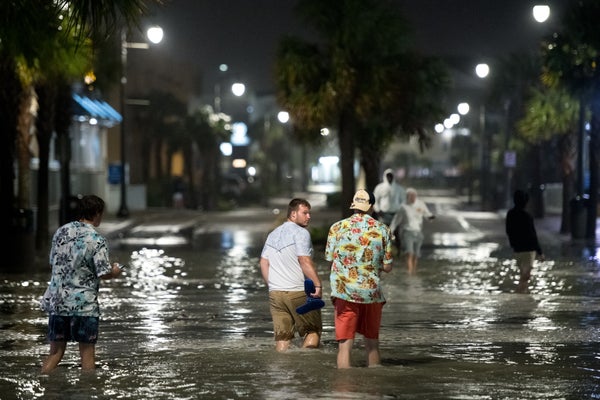
People in the path of Hurricane Isaias are shunning emergency shelters as officials from Florida to North Carolina have urged evacuating residents to stay with friends or relatives instead or to rent hotel rooms.
Ten shelters were opened in Florida in recent days, yet they received a total of 266 people, according to a Federal Emergency Management Agency report.
In North Carolina, where mandatory evacuation orders are in place for parts of three coastal counties, 17 shelters have been opened with a combined capacity of 2,300. The shelters were largely empty last night, a state website shows.
On supporting science journalism
If you're enjoying this article, consider supporting our award-winning journalism by subscribing. By purchasing a subscription you are helping to ensure the future of impactful stories about the discoveries and ideas shaping our world today.
"We've got a lot of people really scared because of the COVID situation, and they will stay at home," Edward Conrow, emergency manager in Brunswick County, N.C., said in an interview yesterday.
Brunswick County, in North Carolina's southeast corner, ordered evacuations from some beachfront communities and opened two emergency shelters yesterday in local public schools. But the county's website says "shelters should be only considered as a last resort" and lists rules that require residents to wear masks "at all times" and to "remain in their assigned section of the building at all times."
Officials are warning about shelters even as they have made them more spacious to facilitate social distancing during the COVID-19 pandemic. The two Brunswick County shelters are limited to 200 people each — far below their typical capacity of 500, Conrow said.
The precautions about shelters also have forced officials to emphasize that residents should not stay at home if they have been ordered to evacuate.
"Don't let concerns about COVID-19 prevent your evacuation," North Carolina Emergency Management Director Mike Sprayberry said yesterday at a briefing on Isaias. "Try to stay with family, friends or at a hotel to minimize contact with others during the pandemic. Remember, if you're told to evacuate, don't hesitate."
More than 2,000 hotel rooms were available in North Carolina for evacuees, Sprayberry said, though it was not clear whether the cost would be covered by government agencies or paid by individuals.
The economic devastation and job losses from the pandemic will create "a real struggle financially for folks" to rent a hotel room during a hurricane, former FEMA Administrator Craig Fugate said yesterday on a podcast by Johns Hopkins University.
Isaias (pronounced ees-ah-EE-ahs) had regained hurricane strength when it made landfall near Ocean Isle Beach, N.C., as a Category 1 hurricane last night with maximum sustained winds of 85 mph. It was the second hurricane of the year, following Hurricane Hanna, which hit Texas in late July.
As it moved through eastern North Carolina this morning, Isaias was downgraded to a tropical storm.
Isaias will have "dangerous winds and storm surge" when it hits the Carolinas, the National Weather Service said last night. Storm surge warnings were in effect last night along the North Carolina and South Carolina coast. Up to 8 inches of rain was forecast in the Carolinas and the mid-Atlantic United States.
"The status or category of a storm can be misleading," Gov. Roy Cooper (D) of North Carolina said yesterday. "You should take this storm seriously."
Conrow of Brunswick County said his "biggest concern is that the system is [a] tropical storm, so people are downplaying it" and will ignore evacuation orders. "That would be a danger for the community and a danger for emergency services workers who have to go out and rescue them," he said.
Isaias caused minimal problems in Florida and resulted in no mandatory evacuation orders. Palm Beach County, with 1.5 million people, had a voluntary evacuation order for coastal areas and opened several "shelters of last resort" that provided only snacks and light meals instead of the customary full breakfast, lunch and dinner.
"This was more of an exercise than a real event," Palm Beach County Emergency Management Director Bill Johnson said at a briefing Sunday.
Isaias was taking aim at Florida and the Carolinas as the states have seen huge surges in COVID-19 infections.
The number of cases in Florida has soared to 487,000 from 57,000 on June 1, the first day of the Atlantic hurricane season. That's the second-highest rate of growth of any state, behind only Arizona.
South Carolina saw its COVID-19 case load jump to 91,000 from 12,000 on June 1, the fourth-largest rate of growth.
North Carolina now has 125,000 infections, up from 29,000 on June 1.
The Associated Press contributed.
Reprinted from Climatewire with permission from E&E News. E&E provides daily coverage of essential energy and environmental news at www.eenews.net.