
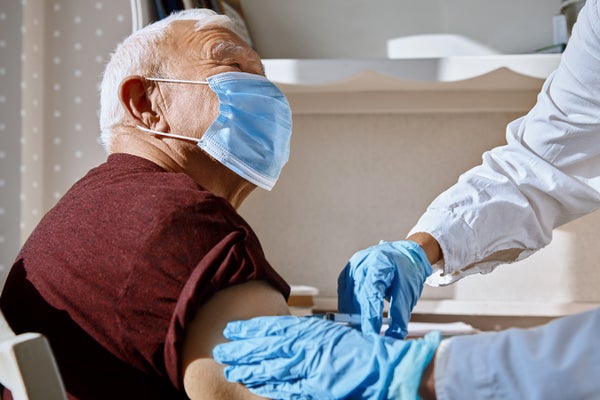
In 2013 public health officials in Wales faced a conundrum: they had just received a vaccine for shingles called Zostavax, but the supply was not large enough to vaccinate all of the older people in the country. As a fix, the officials set a cutoff date based on data that suggested the vaccine was more effective in those younger than age 80: anyone born before September 2, 1933, was ineligible for the vaccine, and anyone born on or after that date was eligible for at least one year.
This unusual public health policy inadvertently created a real-world experiment that has provided the strongest evidence to date that shingles vaccination appears to have a protective effect against Alzheimer’s disease and other forms of dementia. According to findings published this week in Nature, people who received the vaccine were 20 percent less likely to develop dementia over the next seven years compared with those who remained unvaccinated. (Zostavax was eventually replaced with another shingles vaccine called Shingrix in the U.K., the U.S. and many other countries. The authors of the new study noted that they focused on Zostavax because Shingrix didn’t become available in the U.K. until after their follow-up period.)
“This study really shows that there seems to be a causal, protective effect of shingles vaccination preventing or delaying dementia,” says Pascal Geldsetzer, an assistant professor of medicine at Stanford University and senior author of the study. “We are really looking, here, at cause and effect—not just correlation.”
On supporting science journalism
If you're enjoying this article, consider supporting our award-winning journalism by subscribing. By purchasing a subscription you are helping to ensure the future of impactful stories about the discoveries and ideas shaping our world today.
Evidence has been building for years that certain viruses might contribute to some cases of dementia and that vaccinations against these viruses could lower that risk. Most previous research was conducted on cells or laboratory animals, though, or consisted of observational studies that compared people who chose to get vaccinated with those who did not in a given population. Such observational studies have fundamental limitations because researchers cannot easily control for other relevant behavioral differences, such as diet and physical activity levels, between the two groups.
The “beautiful” data provided by the vaccination program in Wales get around this limitation, Geldsetzer says, because the only difference between those who were and were not vaccinated was a slight difference in when they were born. Birthdays were thus equivalent to a coin flip used to assign participants to one group or another in a randomized trial.
For the new study, the researchers compared people whose 80th birthday fell within a week of the vaccine cutoff—either just missing it or just making it. Virtually none of those who had a birthday in the week prior to the cutoff received the shingles vaccine, while 47 percent of those who were eligible opted to get vaccinated.
The researchers compared the health outcomes of both groups over the next seven years and found that one in eight people in total went on to be diagnosed with dementia. Those who received the shingles vaccine because they were eligible, however, were 20 percent less likely to develop dementia than those who didn’t receive it because they were ineligible. All other factors that the researchers examined—including education level, rates of other vaccinations or diagnoses with common diseases—were the same between the two groups.
The findings suggest that the shingles virus might play a role in causing at least a subset of dementia cases, Geldsetzer says, and the vaccine may protect against that. Alternatively, it could be that certain vaccines, such as the one for shingles, lead to a broader immune system activation that lowers the risk of dementia developing.
Geldsetzer and his colleagues now hope to raise funds to conclusively test these possibilities through a randomized controlled trial. If the findings hold up, they will be of “huge importance” for helping researchers better understand the underlying drivers of Alzheimer’s disease and other forms of dementia, he says. That would also suggest that vaccinations for shingles and certain other viral diseases could be an affordable and effective public health measure to delay or prevent dementia from developing in some people in the first place.
“This is a well-done study that provides novel evidence that the live-attenuated [shingles] vaccine might reduce risk of dementia,” says Alberto Ascherio, a professor of epidemiology and nutrition at the Harvard T.H. Chan School of Public Health, who was not involved in the research. The implications, he adds, go well beyond the particulars of this particular vaccine. “It will be important to expand future research broadly on the potential role of infections and vaccinations in determining dementia risk,” Ascherio says.
Editor’s Note (4/3/25): This article was edited after posting to clarify that the study focused on the older shingles vaccine Zostavax.