
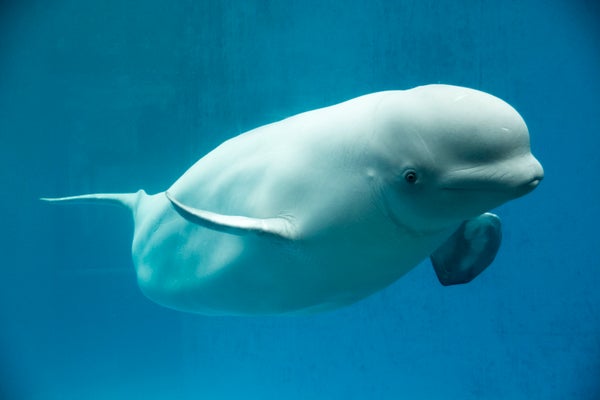
New research suggests that marine mammals in the Arctic could be threatened by increasing ship traffic as the region’s ice melts.
Narwhals and beluga whales could be especially vulnerable because of their exposure to ships and their sensitivity to disturbances, according to a study published yesterday in the Proceedings of the National Academy of Sciences. Polar bears might be the least vulnerable, with four other important species—bearded seals, walruses, bowhead whales and ringed seals—probably falling somewhere in the middle.
The United States, Russia and China are racing to put icebreakers into Arctic waters as rising temperatures uncover new shipping routes, resource deposits and fishing areas once covered by sea ice. Along with other Arctic Council states like Canada and Denmark, the international community is starting to grapple with the far north’s ecological fragility. Last year, the International Maritime Organization outlined a new Polar Code aimed at minimizing shipping disturbances.
On supporting science journalism
If you're enjoying this article, consider supporting our award-winning journalism by subscribing. By purchasing a subscription you are helping to ensure the future of impactful stories about the discoveries and ideas shaping our world today.
But conservation efforts are getting underway while scientists are still searching for basic information about Arctic wildlife, said Donna Hauser, the study’s lead author and a marine biologist at the University of Washington’s Polar Science Center.
Research is difficult and expensive in the far north, and data are still lacking on the population of some important species and their distribution. These variabilities make it hard to know exactly how wildlife will adapt to human incursions beyond the centuries-old subsistence hunting they’ve faced from local people, Hauser said.
For instance, ringed seals are so understudied that the researchers could only calculate their sensitivity to vessels by looking at data on closely related sister species, Hauser said.
Some of the danger is that ships could strike wildlife. But research from more temperate areas show that even indirect effects, like a shipping lane becoming more noisy, could change animals’ behavior and make it harder for them to live in their traditional ranges.
“All of these marine mammal species use sound for navigation and foraging and communication, so there’s the risk for auditory masking or disturbance,” Hauser said.
The study compared the Northern Sea Route and Northwest Passage with the range of 80 Arctic marine mammal populations during September, the part of year with the least sea ice cover and the most shipping traffic. More than half the subpopulations—42—were exposed to open-water sea routes used by Arctic vessels.
The story differs across the region. Marine mammals around geographic bottlenecks, like the Bering Strait and the eastern Canadian Arctic, were as much as three times more vulnerable than populations in more remote areas, according to the study. That’s because those areas are pinch points that both ships and wildlife must pass through.
That exposure could jump even further as ice continues melting and ships become better at traversing Arctic waters, Hauser said.
The Northern Sea Route off Russia’s coast already supports economically viable traffic, and experts predict human activity in the region will spike as the United States begins building ports, updating maps and establishing the other infrastructure needed to support far-north shipping (Climatewire, June 8).
“We already know vessels are using these increasingly accessible sea routes. We’re no longer in the Arctic that was experienced by Franklin and all the sort of epic Arctic explorers,” Hauser said.
She was referring to Sir John Franklin, the British explorer whose famous “lost expedition” of 1845 in search of a northwest shipping passage ended with few traces beyond some shallow graves, human bones bearing knife marks and a note the crew left after their ships became encased in ice.
Reprinted from Climatewire with permission from E&E News. E&E provides daily coverage of essential energy and environmental news at www.eenews.net.