
I'll never forget the first time I saw “piano juggling.” It was December 1989, on Johnny Carson's The Tonight Show.
Carson's guest played the keys of an oversized piano on the floor—by striking them with bouncing balls. Faster and faster he went, juggling downward. Beethoven's “Für Elise” was amazing enough—but Liszt's rapid-fire Hungarian Rhapsody no. 2? The crowd went crazy. How could anyone nail both the keys and the rhythms with perfect accuracy?
Nobody could. During a close-up, I saw that the “piano” was a single, four-foot-wide touch panel. The “keys” appeared to be just painted on. It didn't matter where the balls hit; each triggered the next note in a programmed sequence. He controlled the rhythm, but the rest was automated. Of course, it's not easy to toss balls in rhythm, and the act is still loads of fun. But the audience clearly believed that he was also hitting specific keys.
On supporting science journalism
If you're enjoying this article, consider supporting our award-winning journalism by subscribing. By purchasing a subscription you are helping to ensure the future of impactful stories about the discoveries and ideas shaping our world today.
Seeing that audience hoodwinked set me up for a life of wondering: Is an artist obligated to reveal how much of his or her creativity is being assisted by technology?
I loved Popular Photography magazine—until it shut down in March, after 80 years. Its aim was to teach readers how to shoot better pictures. To that end, it published, with each image, the settings the photographer had used: “1/400 sec at f/5.6, ISO 1000,” for example. That string of numbers always gave me a sense of hopelessness. How could an amateur like me ever learn what combinations of shutter speed, aperture and sensitivity to light (ISO) to dial up for a certain picture?
Eventually a professional photographer told me a little secret: even the pros often let the camera choose some or all of those settings. They might use, for example, shutter-priority mode (in which the camera chooses the aperture), aperture-priority mode (the camera chooses the shutter speed) or even full automatic mode (the camera chooses everything).
Yet even photographs taken in automatic mode were described in the magazine as, you know, “1/400 sec at f/5.6, ISO 1000.” Yes, those were the settings—but for all the readers knew, the camera chose them, not the person. Those specs misled those of us who aspired to be like the top shooters.
Apple's GarageBand program for Mac computers lets you create fully orchestrated “compositions” just by dragging tiles into a grid. Everything sounds great, whether or not you know anything about rhythm, pitch or harmony. At the time of GarageBand's introduction, its product manager told me that even if the program semiautomates the composition process, it still gives people a taste of the real thing. It could inspire a novice to learn music, maybe take up an instrument.
Agreed. But how can we gauge artists' talent without knowing how much of the work was theirs? Should it affect how much we pay for their output? And what about when commercial musicians use GarageBand to produce their tracks—as Oasis and many indie bands have done?
Everyone knows that technology assists almost every creative endeavor these days, from the moment a four-year-old drips paint onto a turntable to make spin art. We also are aware that Hollywood uses computers for its special effects and that most pop songs are Auto-Tuned and pitch-corrected. But in those cases, the audience is in on the fact that machinery has helped out.
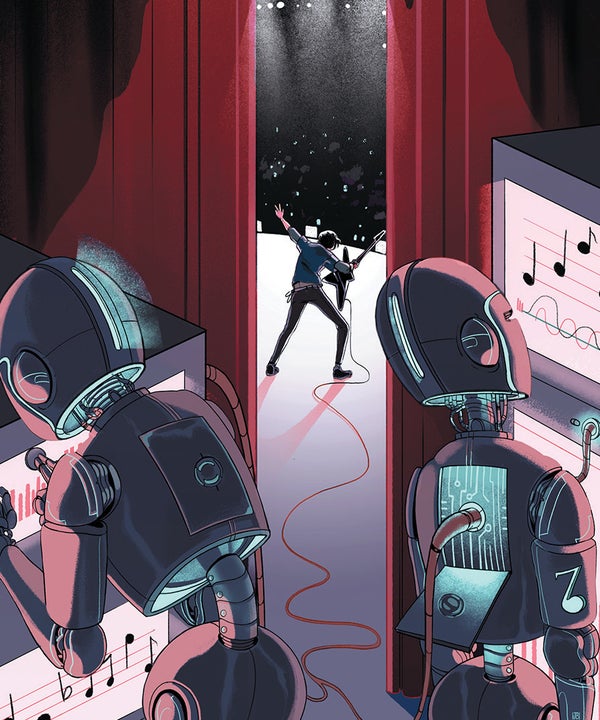
It's not the same thing when technology's assistance is concealed from us and is credited to the human. That's why lip-synching at live concerts is still controversial and why athletes are disqualified for secretly using drugs or other performance enhancements. Disclosing when our creative works have come from canned parts isn't just important for intellectual honesty; it would also make a better barometer for the rising tide of robots entering creative fields. (If you hadn't heard, robots are now capable of composing chorales and painting portraits.)
These days even professional musicians, artists and performers can substitute an on/off switch for human talent. Shouldn't the public know which is which?”