
CLIMATEWIRE | Cities around the world have been testing a new strategy for communicating the dangers of extreme heat. They’re ranking heat waves according to their severity — and in some cases even naming them, the way weather agencies name hurricanes.
In theory, these systems could help improve public awareness about the health risks of extreme temperatures. That’s crucial as global temperatures continue to rise.
But in practice, it’s not clear how much of a difference they make. Most pilot programs ended after one or two summers — with relatively few scientific conclusions about their public impact.
On supporting science journalism
If you're enjoying this article, consider supporting our award-winning journalism by subscribing. By purchasing a subscription you are helping to ensure the future of impactful stories about the discoveries and ideas shaping our world today.
“There are significant governance, operational and scientific concerns with naming heatwaves, and no evidence that they increase awareness or uptake of heat-preventive measures,” wrote Kristie Ebi, an expert on heat and public health at the University of Washington, in an email to E&E News.
A 2022 report from the World Meteorological Organization warned that naming heat waves could have unintended negative consequences, potentially reducing the effectiveness of established heat advisory systems. It also recommended that the WMO conduct further research to evaluate the effectiveness of existing heat wave naming programs around the world.
“What was established for tropical cyclone events may not necessarily be appropriate for heatwaves,” the report noted.
Yet the potential to save lives is enough for some governments to move forward with new heat wave ranking systems anyway.
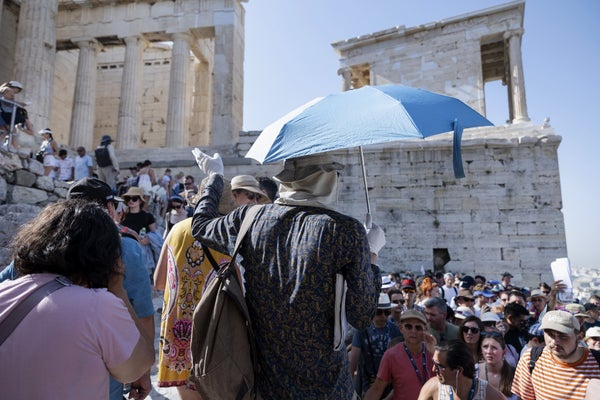
A heat wave ranking program launched in Athens, Greece, in 2021 has now expanded to six cities across the country. The program relies on a tiered system, ranging from category zero, the lowest level, to the most severe heat at Category 3.
Last year, Greece’s national Red Cross society announced a new early action protocol for extreme heat, tied to the ranking system. When heat waves hit the highest threshold, the protocol dispatches teams to check on vulnerable populations and distribute water, sunscreen and other supplies.
Meanwhile, the state of California is developing its own heat wave ranking system in response to a bill passed by lawmakers in 2022.
The system, which is mandated to launch by Jan. 1, 2025, was first proposed by California Insurance Commissioner Ricardo Lara and his California Climate Insurance Working Group, which published a report in 2021 on the dangers of heat, wildfires and other climate-related events.
The report recommended that the commissioner “work with state agencies and the State Legislature to establish a state system to identify and rank heat waves, and to provide information to the public about the projected impacts of each.”
California’s Office of Environmental Health Hazard Assessment officially began work on the ranking program, dubbed the CalHeatScore system, on May 30. The program is still on track to launch by January, according to Tina Cox, an OEHHA section chief.
“We are also planning to engage with indigenous and disadvantaged communities to improve the development of CalHeatScore as these communities may be some of the most susceptible to extreme heat effects,” she added in an email to E&E News.
Pilot programs around the globe
Most other heat wave ranking systems to date have launched in partnership with the Atlantic Council’s Adrienne Arsht Rockefeller Foundation Resilience Center (Arsht-Rock), which has long advocated improved public messaging on the dangers of extreme heat.
Arsht-Rock spearheaded the ranking system in Greece, and it launched the world’s first heat wave naming system in Seville, Spain, as a pilot project in June 2022, with the program concluding last summer.
Seville’s system included three categories for extreme heat, ranging from the lowest at Category 1 to the most severe at Category 3. Each tier triggered various public services, from weather alerts to emergency response efforts such as opening cooling centers and dispatching community health teams to check on vulnerable populations.
Heat waves that reached Category 3 were assigned names in reverse alphabetical order. The pilot program operated from the summer of 2022 through the summer of 2023 and resulted in five named heat waves: Zoe, Yago, Xenia, Wenceslao and Vera.
Last year, Arsht-Rock researchers published a peer-reviewed paper evaluating the program’s impact on public beliefs and behaviors after heat wave Zoe, which struck the city in July 2022 and sent temperatures soaring upward of 110 degrees Fahrenheit.
After surveying residents of southern Spain, they found that only about 6 percent of the respondents recalled Zoe’s name without assistance. These respondents reported more engagement in heat wave safety behaviors than those who could not recall the heat wave’s name.
The implications of the survey are still unclear.
The study suggests there’s some connection between remembering a heat wave’s name and engaging in safer behaviors, like drinking more water, spending more time indoors or checking on neighbors. But it doesn’t prove that the naming system caused these behaviors, meaning it’s not certain that these respondents wouldn’t have done the same things without the name.
That means more research is needed to draw stronger conclusions about the public impacts of naming heat waves.
“This specific pilot program has concluded, but we see this as a real, tangible contribution to the science on the topics of heat risk communication and heat early warning systems,” said Owen Gow, deputy director of Arsht-Rock’s Extreme Heat Resilience Initiative, in an email to E&E News.
Arsht-Rock in recent years has conducted a handful of other pilot ranking systems in U.S. cities, including Los Angeles, Miami, Milwaukee and Kansas City, Missouri, although their results were never publicly communicated.
“We provided access to our system to local National Weather Service offices as a resource, but did not pursue publicly messaging our heat alerts since those communities already receive NWS alerts,” Gow said.
Arsht-Rock is not currently involved in any other heat wave ranking programs worldwide, aside from the ongoing program in Greece. But the organization is still exploring ways to use these kinds of systems to improve public preparedness for extreme heat events and inform insurance products focused on the impacts of heat, according to Gow.
“Arsht-Rock operates on the principle that too many people are being harmed by heat already, and that we should test new and innovative ways to communicate about and respond to dangerous heat,” he said.
Reprinted from E&E News with permission from POLITICO, LLC. Copyright 2024. E&E News provides essential news for energy and environment professionals.