
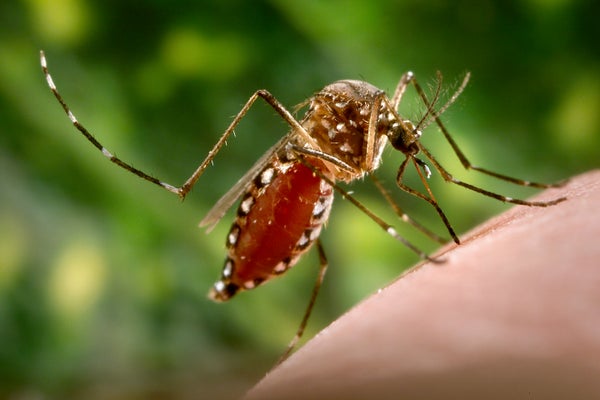
Thousands of cases of the chikungunya virus, which sickens people bitten by an infected mosquito, have broken out in China during the past week. The virus causes extremely severe joint pain and fever, both of which can be short-lived—but can sometimes continue for years. Chikungunya can sometimes cause heart damage. Three days ago, the U.S. Centers for Disease Control and Prevention issued a travel warning for the area of the outbreak (the province of Guangdong in southern China), advising people to take precautions. And experts warn that chikungunya could further spread in the Americas and parts of Europe, though cases there have been relatively rare compared with those in tropical regions. Here is what you need to know about the disease and the risk.
What is the chikungunya virus, and how do people get infected?
The virus was first identified in Africa in 1952. It is spread most often by two mosquito species: Aedes aegypti and Aedes albopictus. People can get sick within three to seven days of a bite. In 2025 about 240,000 cases and 90 deaths have been reported in 16 countries and territories through July. Cases have been reported in the Americas, Africa, Asia and Europe. Infection usually produces symptoms including deeply painful joints, fevers, nausea, fatigue and a rash. Most of the time these problems resolve in a week or two. “But sometimes they can continue for months and years, and the virus can also cause serious heart damage,” says Jean Lim, a microbiologist at the Icahn School of Medicine at Mount Sinai and a member of the Global Virus Network’s chikungunya task force. “In rare cases it can be fatal, and those most vulnerable are people who are immunocompromised, the elderly, and babies.”
On supporting science journalism
If you're enjoying this article, consider supporting our award-winning journalism by subscribing. By purchasing a subscription you are helping to ensure the future of impactful stories about the discoveries and ideas shaping our world today.
What has happened in China?
China has reported an outbreak with about 7,000 cases, mostly in Guangdong and its city of Foshan. The Chinese government has distributed mosquito nets and sprayed insecticide through residential areas, streets and places where people work outside. There have been reports that authorities have forced infected people into hospitals, reminding some of the strict measures China took during the COVID pandemic.
It remains unclear what triggered the outbreak, says Robert Jones, an insect biologist at the London School of Hygiene & Tropical Medicine and another member of the Global Virus Network’s task force. But several weeks of rain and high humidity in the area have created good conditions for A. aegypti and A. albopictus to breed and bite more people, he notes.
Can the virus get from China to the U.S.?
Chikungunya moves easily in this age of fast global travel. There are current outbreaks in France and a case reported in Italy, Jones says. The most likely scenario, according to Lim, is that “a mosquito in China bites and infects someone. That person hops on a plane and flies to the U.S. There a U.S. mosquito bites that person and picks up the virus, and then begins to spread it through the local insect population.”
For this to happen, the new country needs to already have mosquitoes that can host the virus. “Neither of these species is established in the U.K., so there is no risk of onward transmission,” Jones says. But “in the United States, both Aedes aegypti and Aedes albopictus can be found, particularly in the south and east. To date there have been 47 cases of chikungunya confirmed in the U.S. this year.”
Still, there are limiting factors that should minimize worry, says William Klimstra, an immunologist at the University of Pittsburgh’s Center for Vaccine Research. Spraying insecticide and eliminating mosquito breeding areas are effective ways to curb outbreaks. And in a temperate area, the first killing frost will get rid of the insects, stopping viral transmission.
Are there treatments or vaccines for the virus?
Unfortunately, there are no good antiviral therapies, Lim says. Treatment usually consists of supportive care, such as keeping a patient hydrated and managing their pain.
There are, however, two effective and Food and Drug Administration–approved vaccines that get the body to produce antibodies against chikungunya, Jones says, and these lower the risk of infection. One, called IXCHIQ, uses a weakened, noninfective form of the virus. The other vaccine, VIMKUNYA, is based on viruslike particles.
And fortunately, insect repellents and protective clothing work quite well to keep the biting mosquitoes away in outbreak-prone regions of the world.